
Bike lockers, boxes and bike garages
A bike locker or bike box gives every bicycle its own lockable space, sheltered from the rain and out of sight of thieves. From a single box at a station to a full bike garage with access control: we design, supply and install the solution that fits your site.
Alle bike lockers, boxes and bike garages
Prijzen zijn beschikbaar in het Herva-Doublet Platform.


- Our approach
- 1Advice
- 23D design
- 3Production
- 4Installation
- 5Maintenance
What this gives you
From first sketch to maintenance — one partner who handles everything in-house.
One partner, from A to Z
You call one number. We measure, design, produce, install and maintain. No fragmented responsibility, no waiting on subcontractors pointing at each other.
You see it before it exists
A 3D visualisation of your own façade or space, by day and by night. We only start producing once that image is right. No surprises afterwards.
In-house production in Olen
Custom work from our own workshops, without intermediaries. That means a shorter lead time, a sharper price, and changes that are genuinely still possible.
Built to last
ISO 9001 and ISO 14001. Colourfast, weather-resistant materials and energy-efficient LED lighting. With long-term service and maintenance.
What is a bike locker, and when should you choose one?
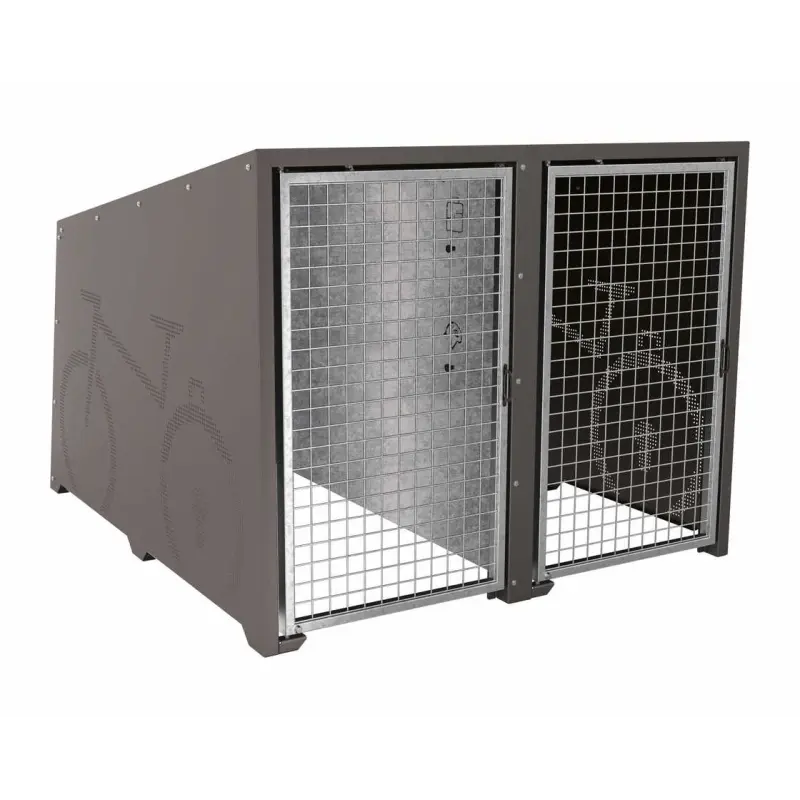
A bike locker is an individual, fully enclosed space for one or two bicycles. Unlike an open rack, it protects not only against theft of the bicycle itself, but also against the removal of components, against vandalism and against the weather. That difference matters where bicycles stand for long periods: station areas, park-and-ride sites, apartment buildings without storage, and business parks where staff leave a bike all day.
Our rule of thumb: the longer the parking duration and the higher the value of the bicycle, the heavier the security may be. For a shopping street where someone stops for twenty minutes, a good rack is enough. For a commuter leaving an electric bike for eight hours, or a resident who needs to store a cargo bike, a lockable box or a collective bike garage is the right choice.
Box, locker or garage: the distinction
Individual bike box
A standalone unit for one bicycle, usually with a door at the front. Boxes are placed in rows or blocks and remain movable as long as they are not anchored. Ideal when you want to start small and expand later: you simply add modules.
Double or stacked locker
Two bicycles per module, side by side or one above the other. This doubles capacity per square metre and is attractive where land or available space is the limiting factor.
Collective bike garage
One enclosed room containing conventional racks or two-tier systems, accessible to a group of users via badge, code or app. Per bicycle this is usually the most economical way to park securely, and it is the form found at stations, schools and larger companies. The drawback: everyone with access reaches every bicycle.
Bike hangar
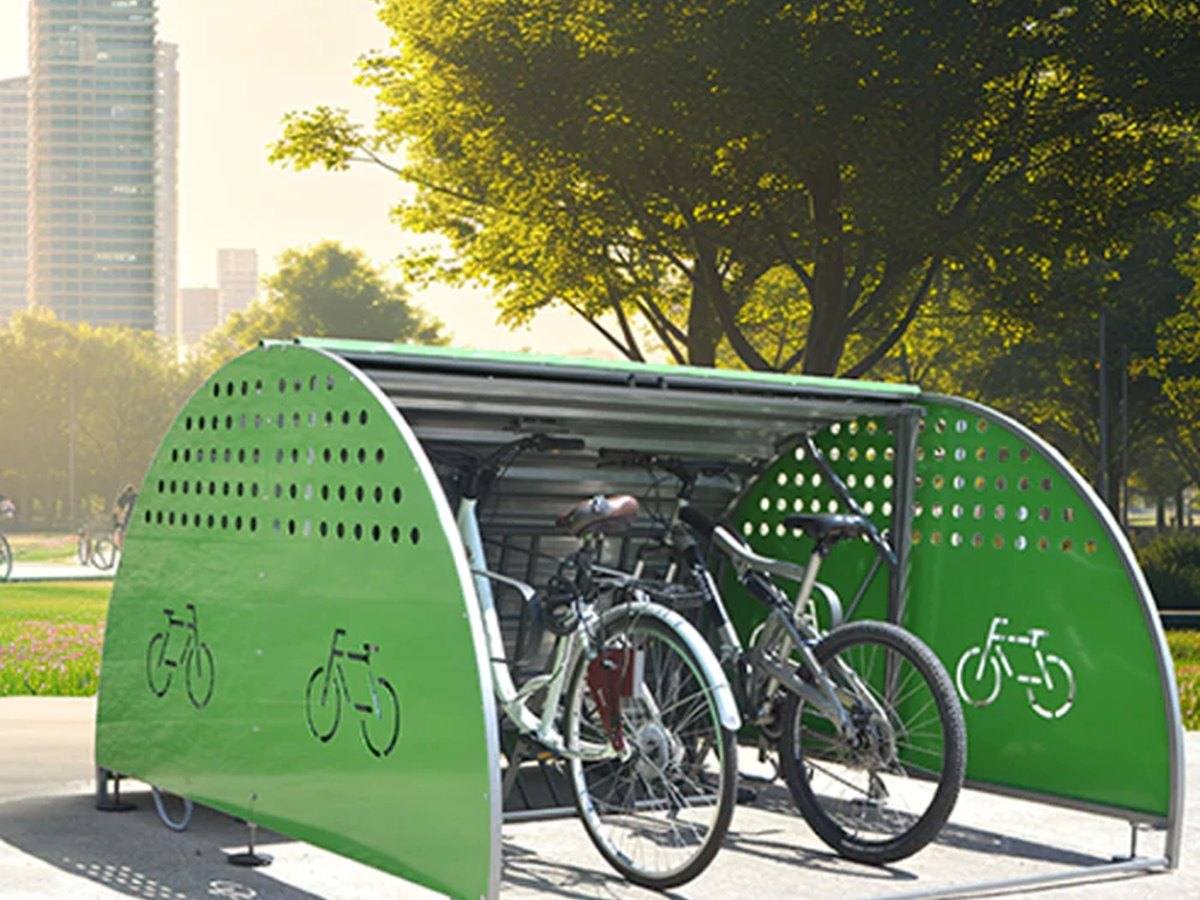
A round or semi-circular cover with a pivoting door, holding five to six bicycles. Popular in residential streets where neighbours share a single facility.
Access control: who gets in?
The locking method determines the management, and the management determines how much work it creates afterwards.
- Fixed key or padlock: simple and cheap, but you manage keys and replace cylinders when they are lost.
- Numeric code: no key management, but a code is easily passed on.
- Badge or tag: users are added and removed individually, and you can see who is entitled to what.
- App and online reservation: users book a place for a day, a month or a year. This is what municipalities choose when they rent out and want payment linked to use.
We look at which layer makes sense with you. Access control at a site with ten boxes and fixed users is usually overkill; at a station with two hundred places and a waiting list it is indispensable.
Materials and service life
Lockers stand outdoors permanently, often near the coast or along a road treated with road salt. That places demands on the material.
- Hot-dip galvanised steel is the standard for the frame: robust, repairable and long-lasting, then powder-coated in a RAL colour or in your house colours.
- Aluminium is lighter and does not corrode, which suits panels and roofs.
- Composite and HPL panels give a closed, even appearance and stand up well to graffiti.
- Perforated sheet or mesh lets light and sight through. That makes a bike garage socially safer, because what happens inside is visible from outside.
For each of these materials there is a trade-off between purchase, maintenance and expected service life. We are happy to work that through for your situation, so you look not only at the investment but at the cost over fifteen or twenty years.
Space, foundation and installation
A bike box needs more room than a rack, so the layout deserves attention before you order. Allow sufficient manoeuvring space in front of the door, a level surface and a sensible orientation relative to the pedestrian route.
The foundation depends on the substrate. On existing concrete or paving, chemical or mechanical anchoring is often enough. On soft ground, concrete footings or a slab are required. We visit the site, take measurements and handle installation, including coordination with your contractor for new build or redevelopment.
Bear in mind today's bicycles as well: cargo bikes, bikes with child seats and electric bikes with a battery need more length, more width and sometimes a socket. We allow for that at the design stage rather than leaving you with modules that turn out to be too small.
Charging points for electric bicycles
More and more clients ask for charging inside the locker. That can range from a simple socket with an individual switch to a managed charging system with a dedicated fuse per place. The essentials are fire safety, correct residual-current protection and clear agreements on who arranges the electrical inspection. We raise these points explicitly during design, because they are often forgotten and expensive to correct afterwards.
What determines the price?
There is no catalogue price for a bike locker, and for good reason. The final cost is driven by choices that differ from project to project:
- The number of places and whether they are individual or collective.
- The choice of material and level of finish.
- The type of locking, from a simple padlock eye to a full badge or reservation system with software.
- The existing ground and the foundation that follows from it.
- Additional technology: lighting, charging points, camera brackets, roofing or a green roof.
- Installation itself: site accessibility, working in a traffic-free zone, phasing.
Two projects with the same number of bicycles can therefore differ considerably in cost. We would rather give you a correct, detailed estimate based on your plan than an indicative price that does not hold. Send us your layout sketch and the number of places required, and you will receive a well-founded quotation.
For municipalities and public tenders
We are familiar with public procedures and supply the documents a specification requires: technical data sheets, material schedules, installation details, maintenance instructions and references to comparable projects. Where the specification imposes performance requirements on burglary resistance, wind load or accessibility, we test the design against them before submission. Wondering whether your design note is realistic? Put it to us; we will say honestly where the sticking points are.
Maintenance and management
A bicycle facility that looks neglected after three years stops being used. Plan the management from the start: periodic checks of hinges and locks, repair of the coating where damaged, and a point of contact for users. We supply spare parts and can take on maintenance, including for facilities we did not install ourselves.
Let us look at what fits
Give us your location, the number of bicycles, the user group and the average parking duration, and we will draw up a proposal with a plan, material choices and phasing. Torn between boxes and a collective garage? We will set both scenarios side by side with their advantages and drawbacks, so you can weigh it up yourself.
Projects
All projects
Frequently asked questions
Wat is het verschil tussen een fietskluis en een fietsbox?
Wanneer kies ik voor losse boxen en wanneer voor een collectieve fietsgarage?
Past een bakfiets of een elektrische fiets in een standaardbox?
Kan er een laadpunt voor elektrische fietsen in?
Welke fundering is nodig?
Wat kost een fietskluis?
Didn't find what you were looking for?
What you see here is a selection. Our range is considerably wider — in sizes, materials and finishes that we cannot all show online. Tell us what you need it for and where it has to go, and we will work out what fits.
Ask your questionAccess to prices and ordering
Request access to our Herva-Doublet Platform. We review your request personally.