Foam board
Lightweight foam board for temporary or light indoor applications: decoration, displays and exhibition dressing. Outdoors it does not stand up to wind or damp.

Foam board is the lightest panel of the lot: a foam core between two thin facing sheets. You hang it with double-sided tape and it weighs next to nothing. Indoors that is its great strength; outdoors it is its weakness.

Lightweight foam board for temporary or light indoor applications: decoration, displays and exhibition dressing. Outdoors it does not stand up to wind or damp.
From first sketch to maintenance — one partner who handles everything in-house.
You call one number. We measure, design, produce, install and maintain. No fragmented responsibility, no waiting on subcontractors pointing at each other.
A 3D visualisation of your own façade or space, by day and by night. We only start producing once that image is right. No surprises afterwards.
Custom work from our own workshops, without intermediaries. That means a shorter lead time, a sharper price, and changes that are genuinely still possible.
ISO 9001 and ISO 14001. Colourfast, weather-resistant materials and energy-efficient LED lighting. With long-term service and maintenance.
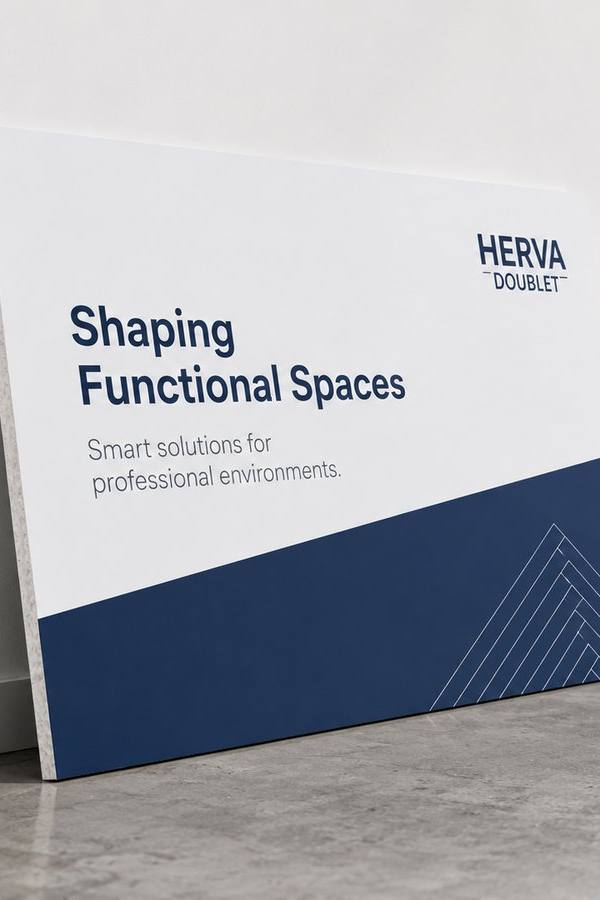
Foam board is a panel with a foam core between two smooth card facings. It is exceptionally light, perfectly flat, and has a matt, even surface that takes ink well. It is also called foamex, foam panel or foam sheet, although in practice that last term often refers to PVC foam sheet, which is a different material.
The difference in one sentence: foam board has a card outer layer and is for indoor use; PVC foam sheet is entirely plastic and can also go outdoors.
Foam board is the material for temporary, lightweight indoor communication. Presentation boards, photo panels, exhibition decor, information boards in a foyer, plans on a wall, mood images in a showroom. It weighs so little that it hangs on a wall with double-sided tape or a couple of clips, without drilling.
Outdoors. And anywhere it can get damp. As soon as the card facing takes up moisture, the panel bows and the facing lifts away from the core. That is not a question of quality but of material choice: if you want to hang something outside, choose PVC foam sheet or aluminium composite.
Impact is a point of attention too. The corners and edges are vulnerable, so in a busy thoroughfare foam board deteriorates faster than a rigid plastic panel.
Foam board comes in various thicknesses. Thin is enough for small panels that are fully supported; thicker is needed as soon as a panel gets larger and hangs from a few points, to stop it sagging. At large sizes the panel thickness becomes the decisive choice, not the size itself.
We print directly onto the panel. Contour cutting is possible, which is what makes foam board popular for cut-out letters, silhouettes and figures in shop windows and at trade fairs. Hanging can be done with tape, hook-and-loop fastening, clips or brackets on the back.
Size and panel thickness set the baseline. Cutting makes the biggest difference: a rectangular panel and a cut-out shape are two different jobs. Beyond that, the quantity counts, whether it is printed single or double sided, and which hanging finish is applied.
We print, cut to size or to contour, and finish with the fixing method that suits your wall. Tell us whether the panel hangs, stands or leans against something, and how large it will be, and we will advise the thickness to match.
What you see here is a selection. Our range is considerably wider — in sizes, materials and finishes that we cannot all show online. Tell us what you need it for and where it has to go, and we will work out what fits.
Ask your questionWe think along from the first sketch through to installation and maintenance.