Event wayfinding
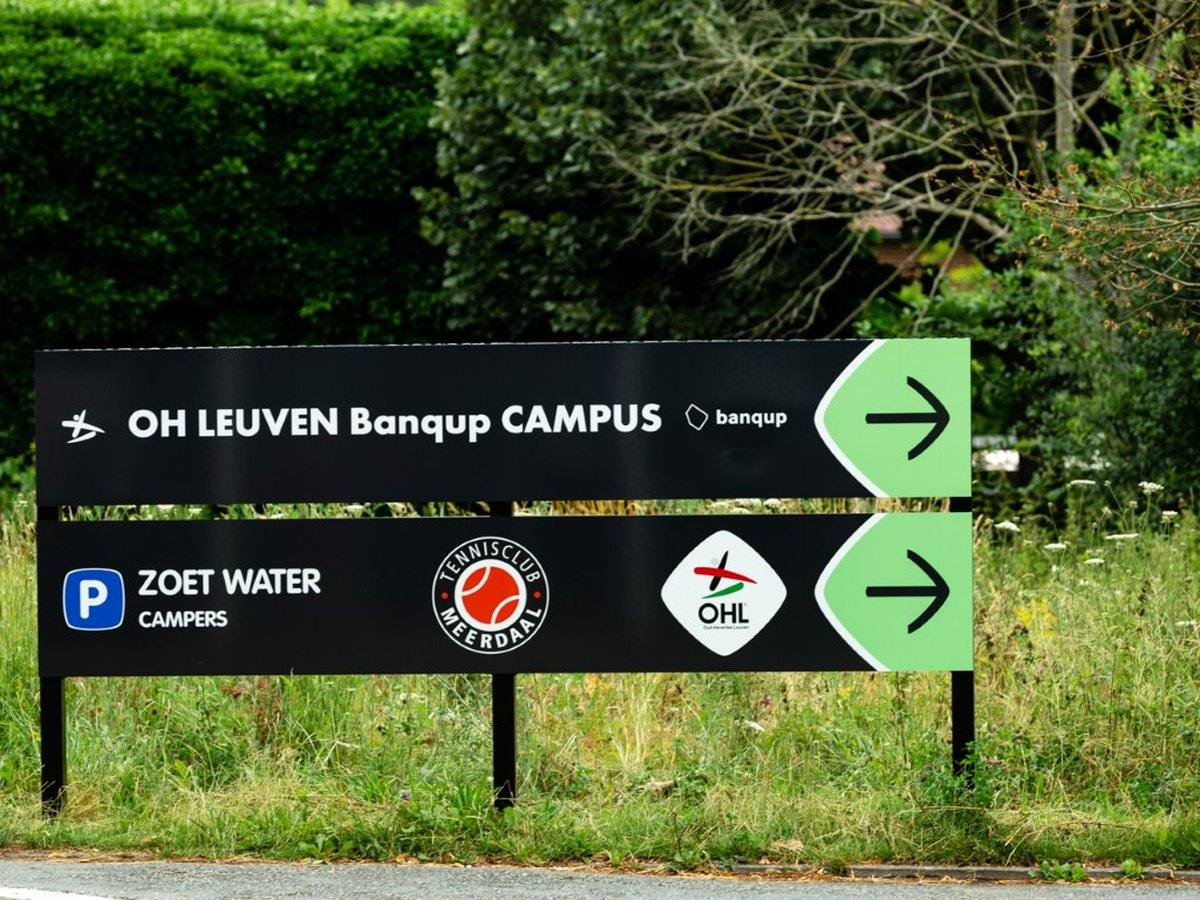
Temporary signage that leads visitors to the entrance, the car park, the stands and the washrooms.
Our approach
- 1Advice
We listen, measure up and think along.
- 23D design
Realistic visualisations for approval.
- 3Production
Custom work in our own workshops.
- 4Installation
Expert installation on site.
- 5Maintenance
Long-term service and maintenance.
What this gives you
From first sketch to maintenance — one partner who handles everything in-house.
One partner, from A to Z
You call one number. We measure, design, produce, install and maintain. No fragmented responsibility, no waiting on subcontractors pointing at each other.
You see it before it exists
A 3D visualisation of your own façade or space, by day and by night. We only start producing once that image is right. No surprises afterwards.
In-house production in Olen
Custom work from our own workshops, without intermediaries. That means a shorter lead time, a sharper price, and changes that are genuinely still possible.
Built to last
ISO 9001 and ISO 14001. Colourfast, weather-resistant materials and energy-efficient LED lighting. With long-term service and maintenance.
Temporary signage for events
Temporary event signage is the set of signs, arrows, banners and floor markings that takes visitors from the car park to the entrance, the stand, the washrooms and the exit without them having to think. It is the least visible part of your event dressing and at the same time the part you are judged on fastest: a visitor who gets lost remembers that longer than the finest stage.
Good event wayfinding is intended for organisers of sports and public events, trade fairs, open days, festivals and municipal festival weeks. We approach it as a route, not as a series of signs. The question is never how many signs you need, but at which points someone has to make a decision.
Where signage is needed
- Approach route and car park direction from the main roads
- From the car park to the main entrance, with distance or walking time
- Junctions on the site where visitors have to choose
- Washrooms, first aid, catering, information desk and assembly point
Versions
The choice of carrier follows from the location. Along an approach route a large sign on a solid base or fixed to fencing works well. On the site itself, A-boards, banners and fence banners are practical because they are quick to move if visitor flows run differently than expected. For indoor areas you use lighter signs, hanging banners or floor stickers. At evening events, illuminated or reflective versions are advisable at the critical points.
Design that works in motion
Keep it to one destination and one arrow per sign. People on the move read two to three words. Use the same names everywhere: if the website says east entrance, the sign should not suddenly say main entrance. Work with a consistent colour system per visitor type, so a participant only has to follow their own colour.
Think about everyone who uses the site. A large enough typeface, strong contrast between text and background, and pictograms alongside the text help visitors who do not read the language or who do not see well.
Material and technique
We work with rigid boards such as foamed PVC or aluminium composite for signs that have to stay sharp and flat, and with fabric on fencing for large surfaces. Floor stickers need an anti-slip version and an adhesive that releases from the substrate in question without leaving residue. Where signage is reused across several editions, a neutral base sign with an interchangeable arrow or text panel is the smartest choice.
Installation, wind and safety
Signs outdoors have to be weighted or anchored. An A-board with an empty base blows over in the first gust and then lies on a walking route where people trip over it. Use filled bases or weights, and couple signs to fencing where you can. Never place a sign in the clear passage of an emergency exit or an emergency services route.
When this is not the right choice
On a small, easily read site where everyone can see the entrance from the car park, extensive signage is unnecessary and even distracting. For a permanent site, temporary signage is not a solution: you need fixed wayfinding there. The biggest mistake is too few signs at the decision points and too many signs in places where only one direction is possible anyway.
What determines the price?
The price depends on the number of signs and their formats, the material chosen, single- or double-sided printing, the number of unique designs and the run, the bases and weighting, and whether we only deliver or also install and collect afterwards. A reusable system with interchangeable panels works out differently per edition than disposable signs. Send us the site plan with the walking routes and we will define the decision points together.
Going through your route plan together
Send us your site plan and the expected visitor flows. We place the signs at the points where they have effect and propose formats and materials. Get in touch for a quotation.
Projects
All projects
Frequently asked questions
Kunnen we de bogen meerdere jaren gebruiken?
Hoe snel staat een opblaasbare boog recht?
Zijn de podia modulair?
Verzorgen jullie ook de opbouw?
Didn't find what you were looking for?
What you see here is a selection. Our range is considerably wider — in sizes, materials and finishes that we cannot all show online. Tell us what you need it for and where it has to go, and we will work out what fits.
Ask your questionReady to start your event wayfinding project?
We think along from the first sketch through to installation and maintenance.