
Displays
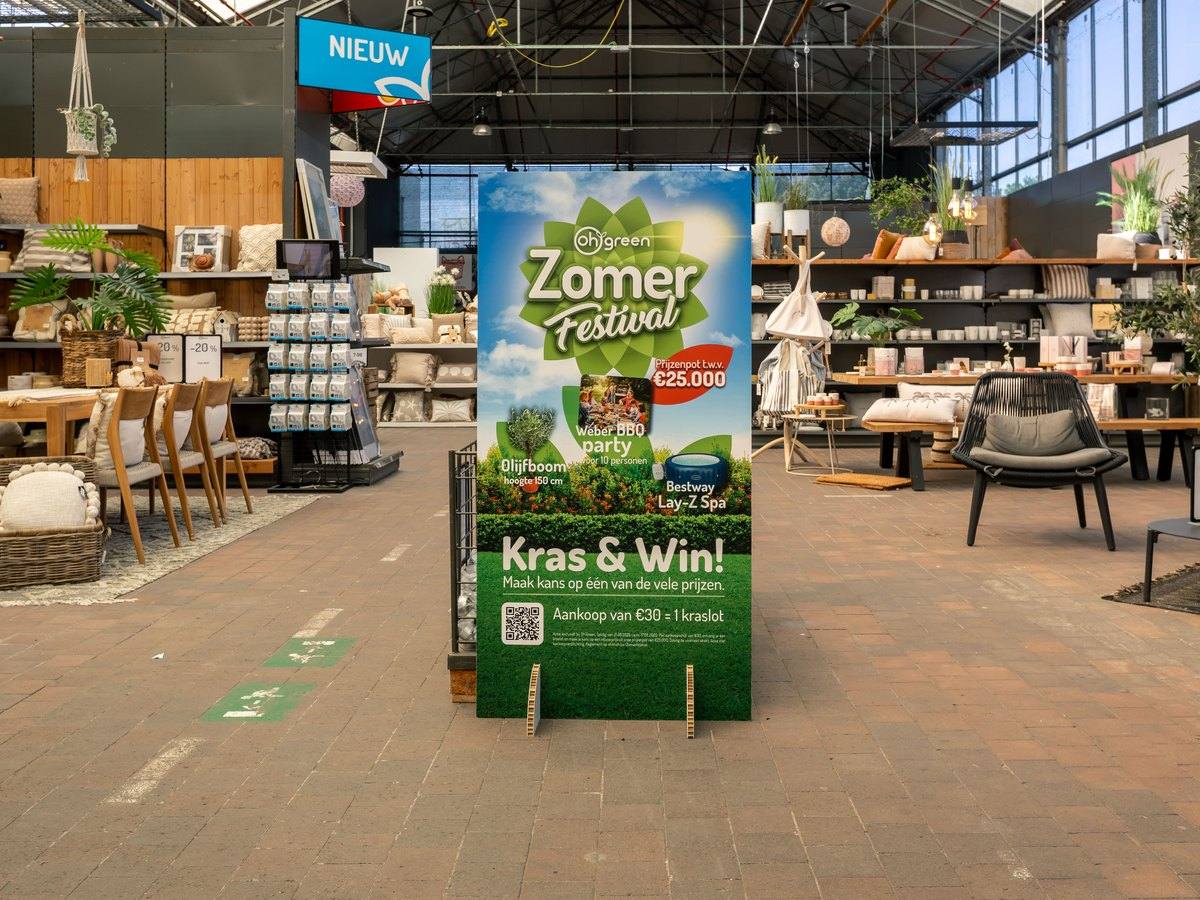
Displays that put products and messages in the spotlight on the shop floor. In many shapes, from counter to floor display.
Our approach
- 1Advice
We listen, measure up and think along.
- 23D design
Realistic visualisations for approval.
- 3Production
Custom work in our own workshops.
- 4Installation
Expert installation on site.
- 5Maintenance
Long-term service and maintenance.
What this gives you
From first sketch to maintenance — one partner who handles everything in-house.
One partner, from A to Z
You call one number. We measure, design, produce, install and maintain. No fragmented responsibility, no waiting on subcontractors pointing at each other.
You see it before it exists
A 3D visualisation of your own façade or space, by day and by night. We only start producing once that image is right. No surprises afterwards.
In-house production in Olen
Custom work from our own workshops, without intermediaries. That means a shorter lead time, a sharper price, and changes that are genuinely still possible.
Built to last
ISO 9001 and ISO 14001. Colourfast, weather-resistant materials and energy-efficient LED lighting. With long-term service and maintenance.
Displays for the shop floor
Displays put a product or a message on the shop floor exactly where the decision is made: next to the till, at the end of an aisle, or as a free-standing island in the middle of the walkway. A good display does three things at once. It stands out, it presents the products neatly, and it still looks cared for at the end of the promotion. That last point is where most displays fall down.
We make displays for brands, retailers, wholesalers and distributors. The request usually comes from a trade marketer or an account manager who has to roll out a promotion across dozens or hundreds of outlets, where transport, ease of assembly and reusability count just as much as the look.
Types and applications
- Counter displays: small, close to the till, for impulse purchases.
- Floor displays: free-standing, with several shelves, for a complete promotion.
- End-cap displays: at the end of an aisle, facing the flow of shoppers.
- Pallet displays: a full pallet converted into a presentation, for high volumes.
- Shelf-ready packaging: cases you open and place straight into the shelf as a presentation.
Versions
Cardboard
The classic choice for temporary promotions. Light, fully printable, shipped flat and simply recycled with the waste paper afterwards. With the right board build-up, a display like this carries a surprising amount of weight.
Plastic
For promotions that run for months or for damp environments. Sturdier and easier to clean than cardboard.
Metal and wood
Semi-permanent displays that stay on the shop floor for years. More expensive to buy, but with interchangeable graphic frames that you replace per campaign.
Material and technique
With cardboard, the flute grade determines the load capacity: a fine flute gives a smoother print result, a heavier flute carries more. We choose that combination based on the product weight that will sit on each shelf, and not the other way round. A display that sags no longer sells.
Pay attention to the finish as well. A matt varnish limits reflection under shop lighting and is less prone to fingerprints than high gloss. In environments with damp or chilled products a moisture-resistant treatment is essential, otherwise the board collapses within days.
Large retail chains often apply their own guidelines on dimensions, stability and materials. Ask for that specification before you design: a display that fails approval never reaches the shop.
In practice
- Always test a physical prototype with real products in it. On screen every display looks stable.
- Keep the number of assembly steps low. Shop staff do not have ten minutes per display.
- Put the key message at the top, at eye level. Anything below knee height goes unread.
- Common mistake: cramming the display full of text. One message, one image, and the product visible. The rest is noise.
For a permanent presentation on a busy shop floor, cardboard is not a good choice; it will look damaged after three weeks. If your promotion is short or the rollout is large, cardboard is in fact the most sensible solution.
What determines the price?
- The type of display, the dimensions and the number of shelves.
- The material and the load capacity required per level.
- The print run: cutting die and set-up costs are spread across the number of units.
- Printing: number of colours, ink coverage and the requested finish or varnish.
- The design and prototyping stage, including testing with real products.
- Distribution: a single delivery or shipping to dozens of outlets.
Tell us about your promotion
Send us the product, the presentation you have in mind, the number of outlets and the duration of the promotion. We will propose a display concept with the right material choice and provide you with a quotation, prototype included.
Projects
All projects

Frequently asked questions
Kan ik enkel de print vervangen bij een nieuwe actie?
Wat is het verschil tussen een totem en een reclamezuil?
Wat is een photocall?
Kunnen onze winkels zelf bijbestellen?
Didn't find what you were looking for?
What you see here is a selection. Our range is considerably wider — in sizes, materials and finishes that we cannot all show online. Tell us what you need it for and where it has to go, and we will work out what fits.
Ask your questionReady to start your displays project?
We think along from the first sketch through to installation and maintenance.