
Traffic signs
Traffic signs compliant with the applicable standards for dimensions, retroreflection and installation. With the technical data sheets your file needs.
Our approach
- 1Advice
We listen, measure up and think along.
- 23D design
Realistic visualisations for approval.
- 3Production
Custom work in our own workshops.
- 4Installation
Expert installation on site.
- 5Maintenance
Long-term service and maintenance.
What this gives you
From first sketch to maintenance — one partner who handles everything in-house.
One partner, from A to Z
You call one number. We measure, design, produce, install and maintain. No fragmented responsibility, no waiting on subcontractors pointing at each other.
You see it before it exists
A 3D visualisation of your own façade or space, by day and by night. We only start producing once that image is right. No surprises afterwards.
In-house production in Olen
Custom work from our own workshops, without intermediaries. That means a shorter lead time, a sharper price, and changes that are genuinely still possible.
Built to last
ISO 9001 and ISO 14001. Colourfast, weather-resistant materials and energy-efficient LED lighting. With long-term service and maintenance.
Road signs for private sites and the public domain
Road signs govern who may drive where, how fast and in which direction. On the public road the design is tightly regulated; on a company site, a car park or a school environment you have more freedom, but the same principle applies: a sign only works if it is recognised without thinking.
We supply road signs to local authorities, contractors, companies, schools and the managers of sites and car parks. From a single sign to the complete signage of a newly laid out zone, including posts, brackets and installation.
The categories and what they mean
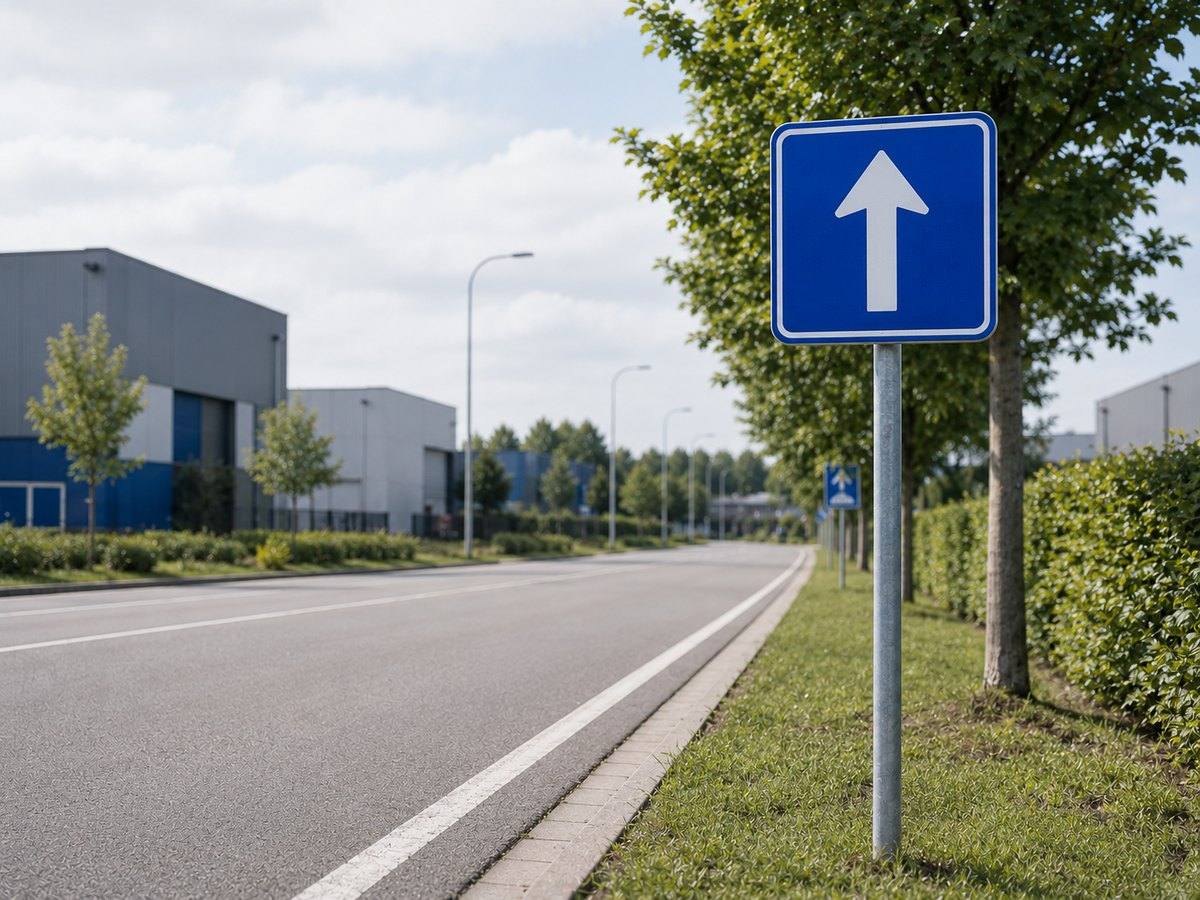
- Mandatory signs: round and blue, they prescribe what you must do, such as compulsory direction of travel, cycle path or footpath.
- Prohibitory signs: round with a red border, they forbid, such as no entry, no parking or a speed limit.
- Warning signs: triangular with a red border, they warn of a narrowing, cyclists crossing or a dangerous bend.
- Priority signs: they set out who goes first.
- Information signs: rectangular and blue, they inform about parking, a 30 km/h zone or a dead end.
On private sites we use the same visual language. A sign of your own invention loses its force, because drivers react to what they recognise from the Belgian highway code.
Retroreflection: the class determines the visibility
The difference between a sign that lights up in your headlights at night and a sign that stays dull lies in the reflective film. There are several classes, from a basic version to high-performance film that stays legible under side lighting and in the rain.
The choice depends on the location. A sign along a lit car park can be produced in a lighter class; a sign along a dark regional road or at an exit where lorries pass at night deserves the highest class. We advise per situation and state the class explicitly on the quotation, so that you know what you are buying. Tender specifications usually prescribe the class; we check against them.
Size and reading distance
The dimensions follow from the speed at the location. The faster the traffic, the earlier the sign has to be read and the larger it therefore has to be. On the public road the sizes are fixed by standards. On a private site we choose the size on the basis of the actual approach speed and the sightline.
A common mistake is a sign that is too small on a post that is too high, or a sign that disappears behind a shrub after two summers. When surveying, we therefore look at the sightline as it will be in a few years, not only as it is today.
Material and mounting
The standard is an aluminium plate with a reinforced edge, finished with reflective film. Aluminium does not rust, stays flat and lasts decades. For temporary signage at works there are lighter versions in plastic or on a movable base.
Mounting is on a galvanised post, on an existing post with brackets, or against a facade or fencing. The foundation depends on the substrate and on the wind load on the sign face: a large sign on a high post needs noticeably more than a small one. We calculate that rather than estimate it.
What is often forgotten
- A sign imposing a rule that nobody enforces undermines every other sign on the site. Better to place fewer signs and make sure they are right.
- On a private site a road sign is only enforceable once it is tied to a set of rules made known to visitors, for instance with an information board at the entrance.
- For works on or beside the public road, separate rules apply to temporary signage, with their own requirements for colour, placement and lighting.
- Damaged or faded signs are better replaced completely than partially: a sign whose film has gone dull no longer reflects and gives a false sense of safety.
What determines the price?
There is no fixed price per road sign. The cost follows from the size, the class of reflective film, whether it is a standard sign or a bespoke one, the number of pieces (with a series of identical signs the cost per piece drops sharply), the posts and brackets, the foundation that follows from the substrate, and the installation conditions, such as working alongside a busy road or outside peak hours.
Send us your plan or a list of signs and locations, and you get a quotation in which every item is visible separately, together with the technical data sheets your file requires.
Submitting your situation
Send us the site plan or a few photos of the location. We will indicate which signs are needed, in which class, and where they are best placed.
Projects
All projects
Frequently asked questions
Voldoen jullie verkeersborden aan de Belgische normen?
Wanneer zijn podotactiele noppentegels verplicht?
Wat is het verschil tussen wayfinding en signalisatie?
Beschermen jullie ook muren tegen heftrucks?
Didn't find what you were looking for?
What you see here is a selection. Our range is considerably wider — in sizes, materials and finishes that we cannot all show online. Tell us what you need it for and where it has to go, and we will work out what fits.
Ask your questionReady to start your traffic signs project?
We think along from the first sketch through to installation and maintenance.