
Speed humps
Speed humps and traffic calmers that enforce speed on sites and car parks. Modular and simple to anchor.

Alle speed humps
Prijzen zijn beschikbaar in het Herva-Doublet Platform.

- Our approach
- 1Advice
- 23D design
- 3Production
- 4Installation
- 5Maintenance
What this gives you
From first sketch to maintenance — one partner who handles everything in-house.
One partner, from A to Z
You call one number. We measure, design, produce, install and maintain. No fragmented responsibility, no waiting on subcontractors pointing at each other.
You see it before it exists
A 3D visualisation of your own façade or space, by day and by night. We only start producing once that image is right. No surprises afterwards.
In-house production in Olen
Custom work from our own workshops, without intermediaries. That means a shorter lead time, a sharper price, and changes that are genuinely still possible.
Built to last
ISO 9001 and ISO 14001. Colourfast, weather-resistant materials and energy-efficient LED lighting. With long-term service and maintenance.
Speed humps that genuinely enforce the speed
A speed hump is the only speed measure that works without enforcement. A sign saying "walking pace" is ignored; a hump is not. On car parks, company sites, campsites, school environments and residential streets, that is the difference between a rule on paper and behaviour on the road.
We supply and install speed humps and traffic calming for local authorities, companies, schools, hospitals, campsites and the managers of car parks and private roads.
Which form for which speed
The height and above all the length of the ramp determine the speed at which a hump becomes uncomfortable. That is the whole craft: too sharp and it damages vehicles and irritates drivers, too flat and it is taken at speed.
- A short, high hump enforces walking pace. Suitable on car parks and sites where people only drive a few dozen metres anyway.
- A longer, flatter hump slows traffic to a higher through speed and is more comfortable for buses and emergency services.
- A raised table is a flat raised surface across the full width, often at a crossing point. It slows traffic and puts the crossing at pavement level, which improves accessibility.
- Speed cushions let wide axles, such as buses and fire appliances, pass with their wheels either side, while cars still have to drive over them. Useful on emergency service routes.
We advise on the basis of the speed you want and who passes through, not on the basis of what happens to be in stock.
Modular or cast in place
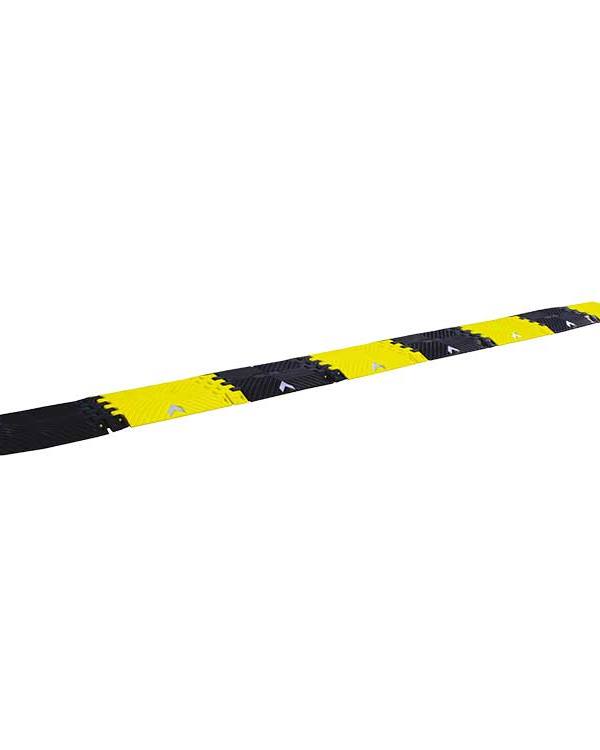
Modular humps in rubber or plastic are delivered in sections and anchored to the existing surface. They are quick to install, movable, and extendable across the width. If one section is damaged, you replace that section. That makes them the logical choice on private sites and anywhere the layout may still change.
Humps cast in asphalt or concrete belong with a definitive rebuild of the public road. They last longer and look calmer, but they need a contractor and can no longer be moved.
Most modular versions are built up from a black centre section with yellow or white end sections. That contrasting colour is not there for looks but for the visibility of the edge.
Installation and points to watch
- Anchoring. On asphalt and concrete, mechanical anchoring is used. A badly anchored hump shifts after one winter and then becomes a hazard in itself.
- Drainage. A continuous hump holds water back. Provide through openings or gaps at the gutter line, otherwise you get a pool after every downpour.
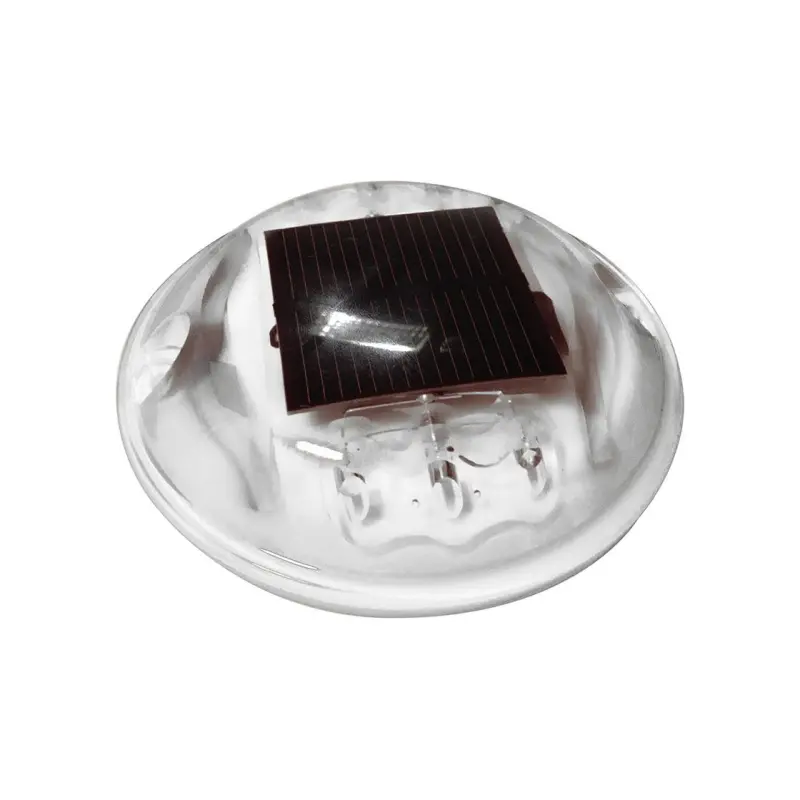
- Advance warning. A hump should be announced with signage and be visible in the dark. Reflective elements in the end sections help.
- Space before and after. A hump immediately after a bend is seen too late.
- Snow clearing. A hump on a route that gets cleared needs a version that can take a plough blade.
What determines the price?
Speed humps have no fixed price per metre. The cost follows from the type and the height, the width of the road and therefore the number of sections, the material (rubber, plastic or cast in place), the end sections and reflective elements, the anchoring and the condition of the substrate, the accompanying signage, and the installation conditions, such as working on a road that stays in use.
Send us the road width, the speed you want and the type of traffic, and you get a quotation in which those items are visible.
Asking for advice
Describe the situation: where is the speeding happening, who passes through, and does the road stay in use during the works. We will propose a specification that suits the traffic that actually uses it.
Projects
All projects
Frequently asked questions
Voldoen jullie verkeersborden aan de Belgische normen?
Wanneer zijn podotactiele noppentegels verplicht?
Wat is het verschil tussen wayfinding en signalisatie?
Beschermen jullie ook muren tegen heftrucks?
Didn't find what you were looking for?
What you see here is a selection. Our range is considerably wider — in sizes, materials and finishes that we cannot all show online. Tell us what you need it for and where it has to go, and we will work out what fits.
Ask your questionAccess to prices and ordering
Request access to our Herva-Doublet Platform. We review your request personally.