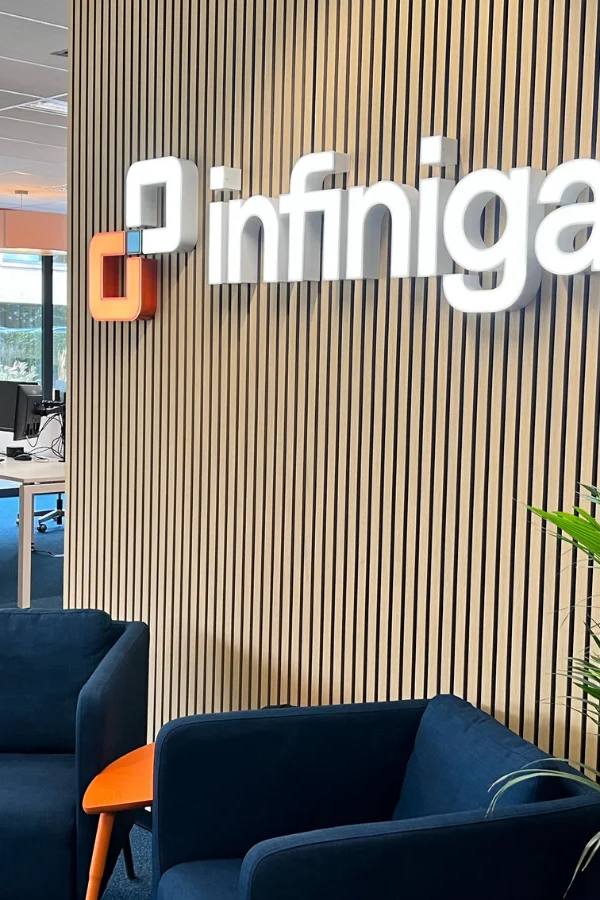
Acoustic panels – wood
Timber slats on an acoustic felt backing. Warm and high-end. For meeting rooms and reception areas where appearance matters. Not printable.

Hard surfaces bounce sound back. In an open-plan office or a canteen, that creates a reverberation that makes conversation unintelligible and tires people out. Acoustic panels absorb that sound. The choice between wood and PET is not about performance — both work — but about appearance, budget and whether you want an image on them.
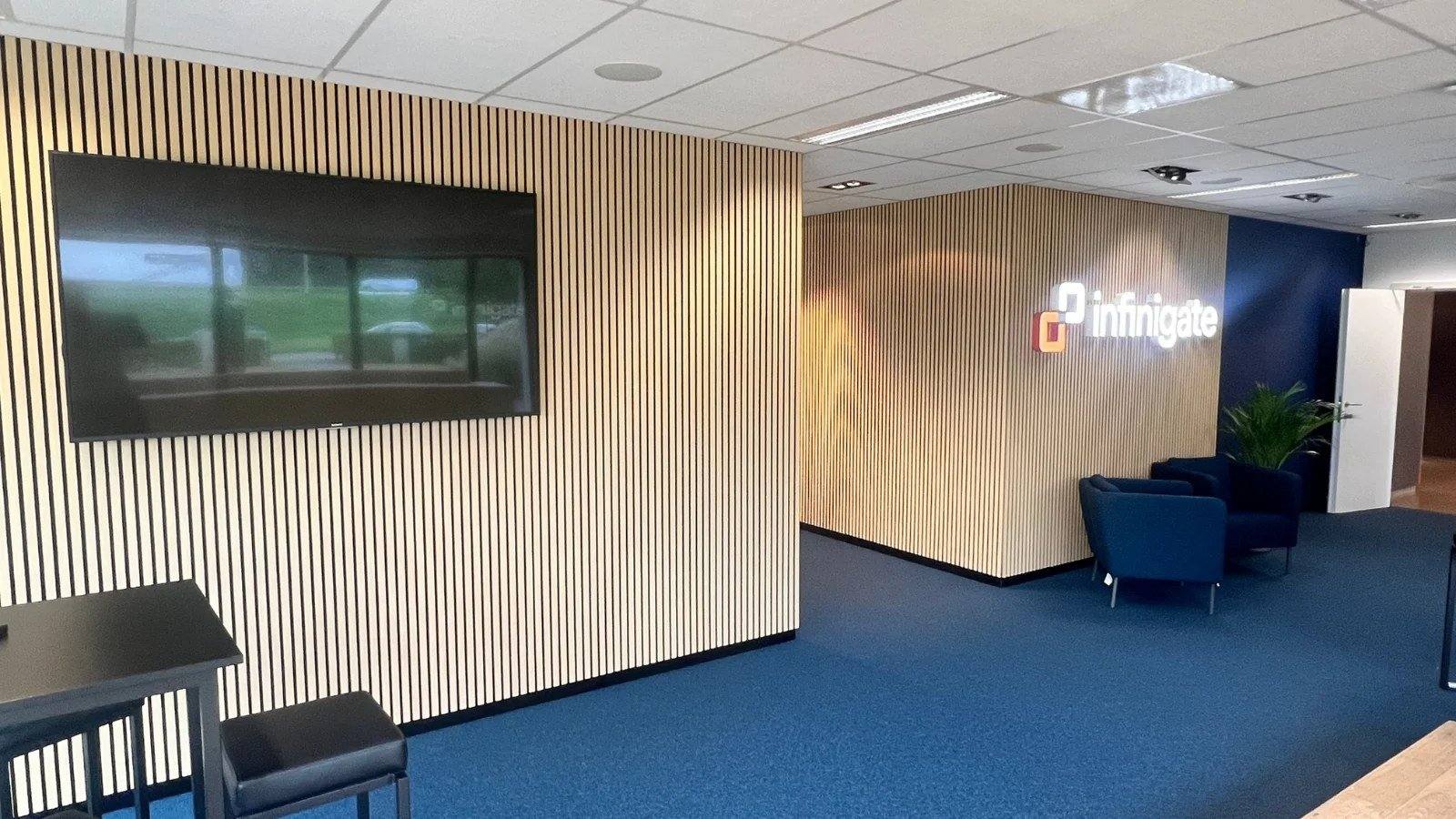
Timber slats on an acoustic felt backing. Warm and high-end. For meeting rooms and reception areas where appearance matters. Not printable.
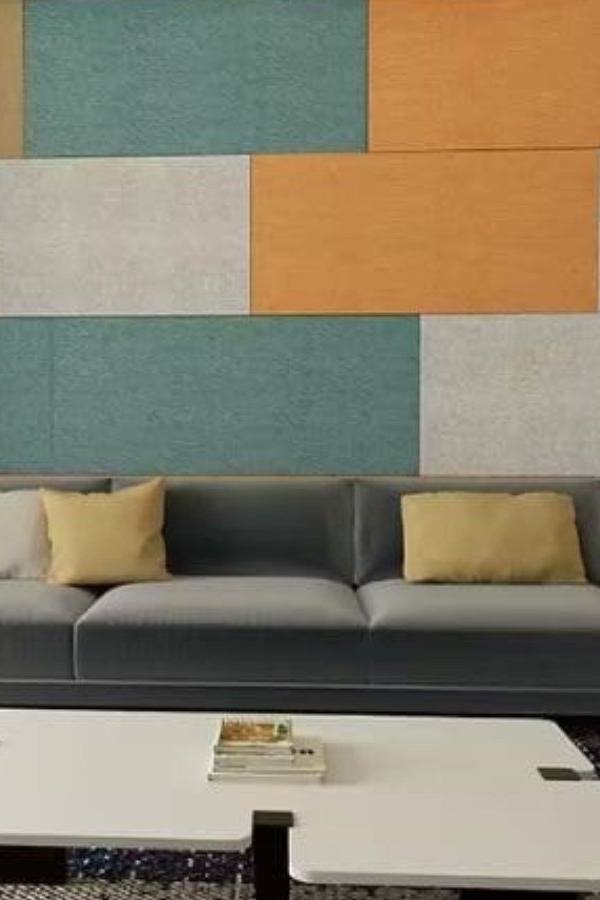
Recycled PET felt, made from plastic bottles. Lighter, fire-safe, more affordable — and fully printable, which turns the acoustics into a brand carrier straight away.
From first sketch to maintenance — one partner who handles everything in-house.
You call one number. We measure, design, produce, install and maintain. No fragmented responsibility, no waiting on subcontractors pointing at each other.
A 3D visualisation of your own façade or space, by day and by night. We only start producing once that image is right. No surprises afterwards.
Custom work from our own workshops, without intermediaries. That means a shorter lead time, a sharper price, and changes that are genuinely still possible.
ISO 9001 and ISO 14001. Colourfast, weather-resistant materials and energy-efficient LED lighting. With long-term service and maintenance.
Sound that hits a hard surface bounces back. In an office of concrete, glass and tiles, every word therefore stays audible several times over before it dies away. We call that reverberation, and it is the reason people in such a space start talking louder of their own accord, after which the problem feeds itself.
Acoustic panels break that cycle. They take in sound energy instead of reflecting it, so the room becomes calmer without anything changing at the source.
Wooden slats on an absorbent backing give the warm, ribbed look you often see in reception areas and meeting rooms. The slats provide the diffusion, the layer behind them the absorption.
Felt and PET panels are made of pressed fibres, often from recycled bottles. They are light, fire safe, available in many colours and easy to cut into shapes. This is the material for anyone who wants to use colour or work with forms.
Fabric panels with an absorbent core combine damping with a printable image, and belong with the acoustic fabric frames.
On the walls that face each other, and on the ceiling. In a long room with two parallel hard walls it is often enough to treat one of the two. Above a meeting table, ceiling baffles, vertically hung strips, do more than wall panels, because there the sound mainly goes upwards.
Full coverage is almost never needed. Spreading them out with gaps between often works just as well and looks calmer.
Felt and PET panels are also used as free-standing dividers or as desk screens. They then split the space visually and acoustically, without any building work.
Material and thickness set the baseline: wood sits above felt, and thicker panels absorb more, certainly at lower frequencies. Beyond that it depends on the fixing, flat on the wall, on spacers or suspended from the ceiling, on the quantity, and on whether bespoke sizes or shape cutting are involved.
How much you need depends on the volume of the room, the existing materials and the use. That is not a question you answer with a surface area alone.
We look at the space, advise on material, quantity and placement, and supply and fit. Send us the dimensions, a few photos and a description of what goes wrong, meetings, phone calls, or just general noise, and a concrete proposal comes out of it.
What you see here is a selection. Our range is considerably wider — in sizes, materials and finishes that we cannot all show online. Tell us what you need it for and where it has to go, and we will work out what fits.
Ask your questionWe think along from the first sketch through to installation and maintenance.