Safety signage and pictograms
Safety signage and pictograms are not a design choice but a legal requirement: shape, colour and symbol are standardised. We supply compliant pictograms, photoluminescent materials and an audit of your existing signage.
Our approach
- 1Advice
We listen, measure up and think along.
- 23D design
Realistic visualisations for approval.
- 3Production
Custom work in our own workshops.
- 4Installation
Expert installation on site.
- 5Maintenance
Long-term service and maintenance.
What this gives you
From first sketch to maintenance — one partner who handles everything in-house.
One partner, from A to Z
You call one number. We measure, design, produce, install and maintain. No fragmented responsibility, no waiting on subcontractors pointing at each other.
You see it before it exists
A 3D visualisation of your own façade or space, by day and by night. We only start producing once that image is right. No surprises afterwards.
In-house production in Olen
Custom work from our own workshops, without intermediaries. That means a shorter lead time, a sharper price, and changes that are genuinely still possible.
Built to last
ISO 9001 and ISO 14001. Colourfast, weather-resistant materials and energy-efficient LED lighting. With long-term service and maintenance.
What is safety signage?
Safety signage covers all the signs and pictograms that indicate a hazard, a prohibition, an obligation or an exit. Unlike the rest of your visual communication this is not a design choice: shape, colour and symbol are standardised, precisely because they must be recognised without thinking and without knowing the language.
We supply safety signage to companies, industrial sites, schools, care institutions, municipalities and building managers, from a single sign to a complete plan with an on-site survey.
The five families a plan consists of
Prohibition signs
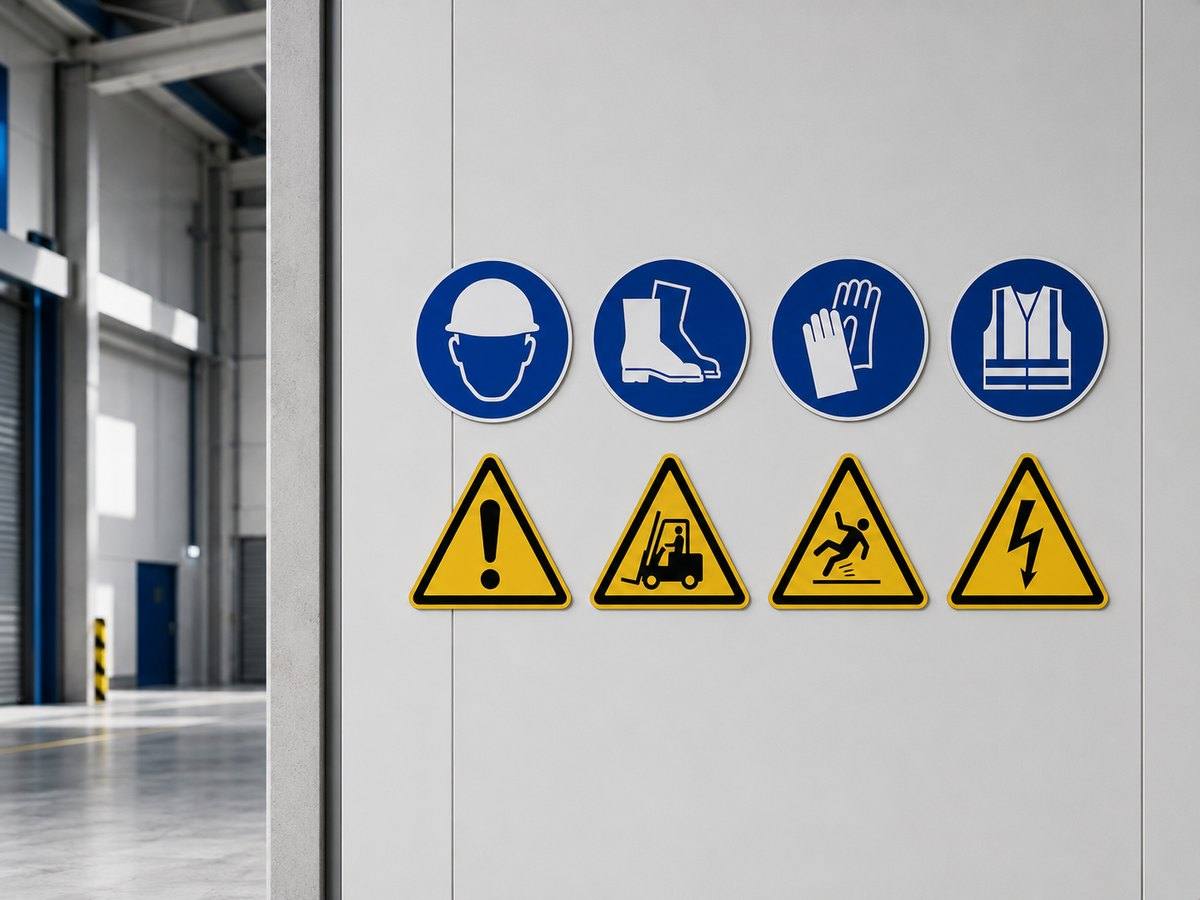
Round, with a red border and diagonal bar on a white background. They show what is not allowed: no smoking, no unauthorised access, do not extinguish with water.
Mandatory signs
Round and blue. They impose behaviour: wear a helmet, safety glasses, safety footwear.
Warning signs
Triangular, yellow with a black border. They flag a hazard: electrical risk, corrosive substances, forklift traffic.
Rescue and escape signs
Rectangular and green. They point the way to the emergency exit, the first aid post or the assembly point.
Fire-fighting equipment
Rectangular and red. They mark the extinguisher, the hose reel, the alarm call point.
A coherent plan contains these five families in the right places, no more and no less. An excess of signs weakens the legibility of the whole.
Where to place them
Prohibition, mandatory and warning signs go at eye height, at the point where the rule starts to apply: at the entrance to a zone, on the door of a plant room, beside a machine. Escape signage goes higher, so it stays visible above people, and at every decision point along the escape route, with confirmation in between.
A common failing: signs that have become obscured over time by furniture, storage or a new partition. It is the first thing an inspection notices, and the easiest to put right.
Versions and materials
- Rigid plastic (PVC or PP): the indoor standard, economical and light.
- Powder-coated or anodised aluminium: for outdoors and demanding environments, resistant to UV and corrosion.
- Stickers: for smooth surfaces, doors and glazing, including transparent versions.
- Photoluminescent material: charges from ambient light and stays visible in the dark. Essential for escape signage, because the indication must remain legible during a power failure or smoke.
- Floor marking: strips and pictograms that withstand forklift traffic and machine cleaning.
- Tactile signs: where touch or darkness makes visual reading insufficient.
Installation
Most signs are fitted by bonding, screwing or on a profile. The choice depends on the substrate and on whether they need to be movable later. In food and care environments we favour smooth surfaces without seams where dirt can lodge. In industry we allow for cleaning, chemicals, heat and moisture.
We can walk the site with you and supply a schedule giving, sign by sign, the position, material and dimension. That makes phased execution straightforward and the budget predictable.
Standards and obligations
The shape, colour and symbol of safety signs are standardised internationally, and Belgian employment law requires their use on the basis of your risk assessment. Which signs are needed therefore depends on your activity and the layout of the building; there is no universal list.
What we see most often in an audit: pictograms from an earlier generation still in place, evacuation plans that no longer match the actual layout, and obscured signage. We produce a schedule of what needs replacing, with a priority per item.
Maintenance and replacement
Photoluminescent material loses effectiveness with age and soiling, so it needs periodic cleaning and checking. Outdoor stickers fade depending on the quality of the film. Aluminium signs last decades. We recommend an annual check, combined with the evacuation drill, and supply identical replacements.
What determines the price?
Safety signage has no fixed price per sign. The cost depends on:
- The number of signs and the number of different formats; repeating one format strongly reduces the unit cost.
- The material and expected service life.
- Whether photoluminescent material is used, which costs more but is required for escape routes.
- Whether an on-site survey and signage plan are needed.
- Installation: height, substrate type, work during or outside opening hours.
- Special requirements: tactile signs, vandal-resistant versions, chemical resistance.
Send us your floor plan or invite us for a survey, and you will receive a proposal itemised per position, together with an order of priority if not everything can be done at once.
Have your signage checked
We walk the site and supply a schedule of missing, outdated or obscured signage, with a proposal per item. That is usually the quickest way to put things in order before an audit or inspection.
Projects
All projects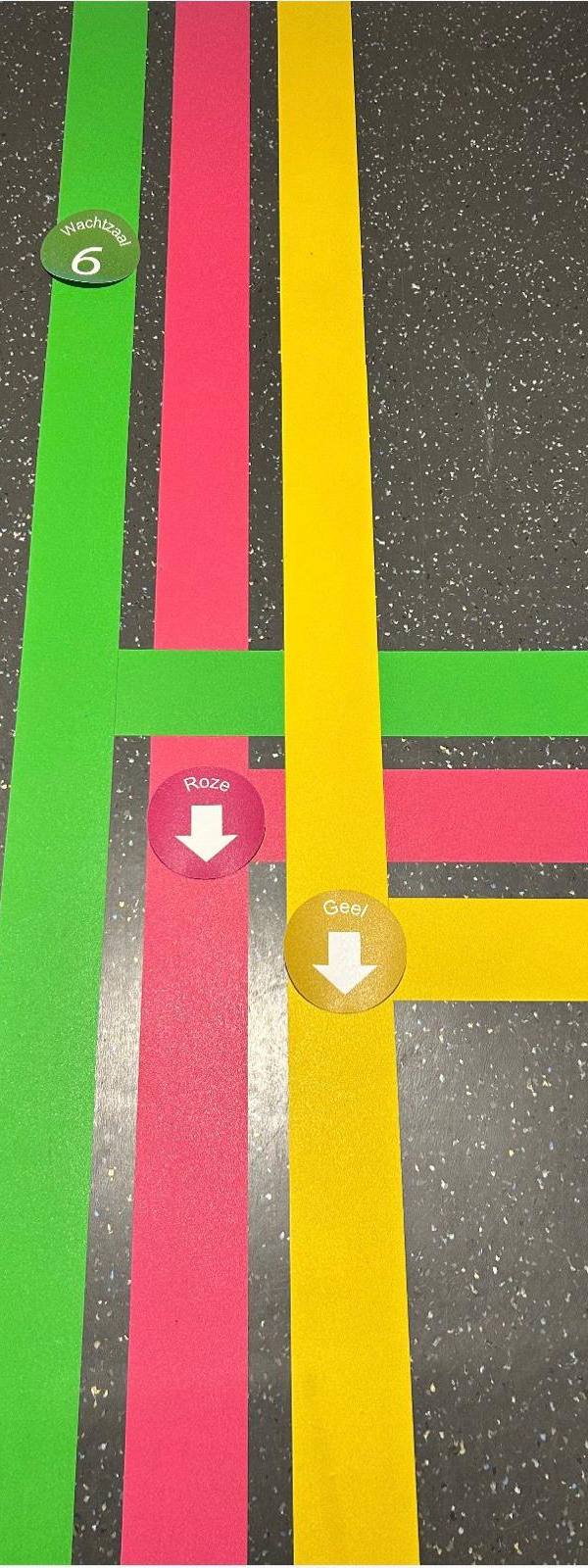
Frequently asked questions
Welke veiligheidsborden zijn wettelijk verplicht?
Wat betekent nalichtend en wanneer is het nodig?
Mag ik zelf een pictogram ontwerpen?
Op welke hoogte hangen veiligheidsborden?
Welk materiaal past in een industriële omgeving?
Kunnen jullie onze bestaande signalisatie nakijken?
Didn't find what you were looking for?
What you see here is a selection. Our range is considerably wider — in sizes, materials and finishes that we cannot all show online. Tell us what you need it for and where it has to go, and we will work out what fits.
Ask your questionReady to start your safety signage and pictograms project?
We think along from the first sketch through to installation and maintenance.