
Crowd-barrier covers
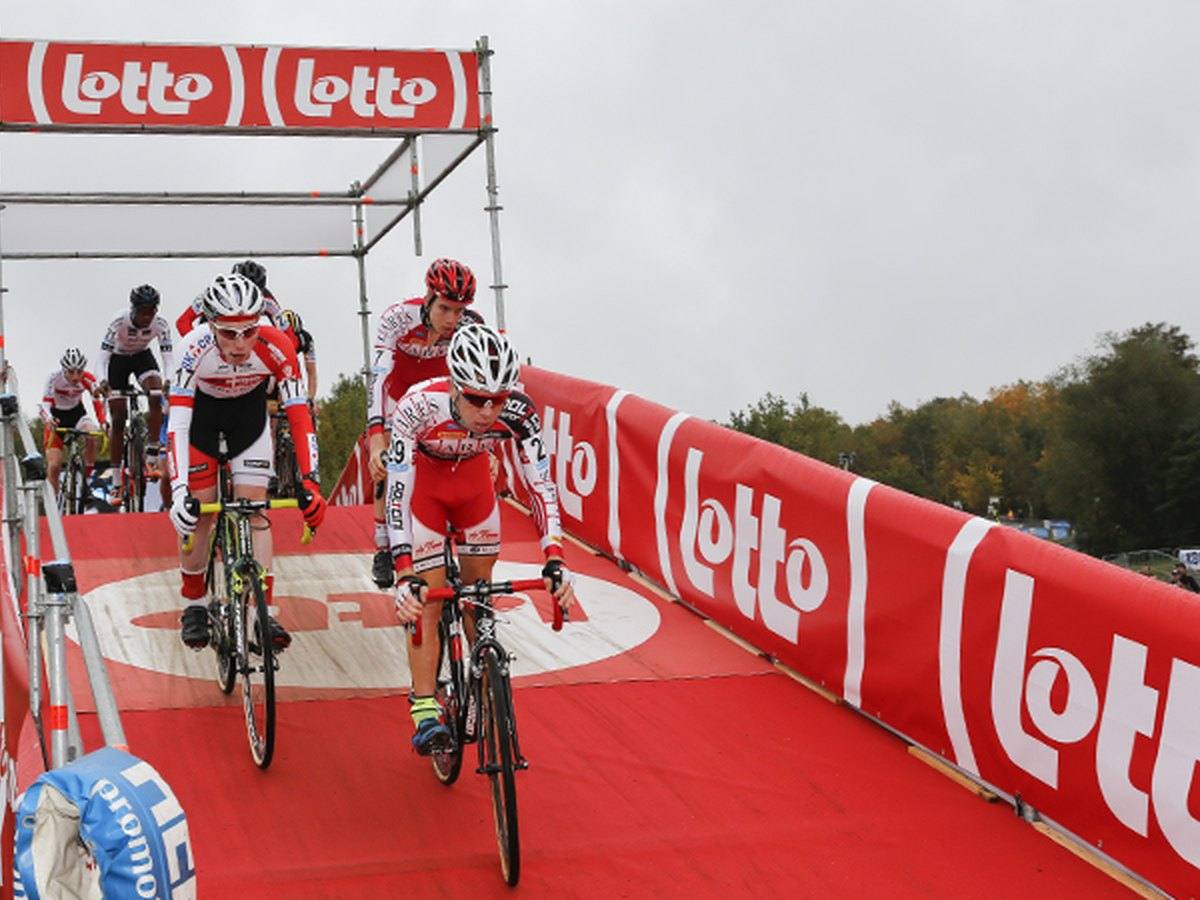
Printed covers that slide over crowd barriers. Deliver sponsor or brand visibility along a route straight away.
Our approach
- 1Advice
We listen, measure up and think along.
- 23D design
Realistic visualisations for approval.
- 3Production
Custom work in our own workshops.
- 4Installation
Expert installation on site.
- 5Maintenance
Long-term service and maintenance.
What this gives you
From first sketch to maintenance — one partner who handles everything in-house.
One partner, from A to Z
You call one number. We measure, design, produce, install and maintain. No fragmented responsibility, no waiting on subcontractors pointing at each other.
You see it before it exists
A 3D visualisation of your own façade or space, by day and by night. We only start producing once that image is right. No surprises afterwards.
In-house production in Olen
Custom work from our own workshops, without intermediaries. That means a shorter lead time, a sharper price, and changes that are genuinely still possible.
Built to last
ISO 9001 and ISO 14001. Colourfast, weather-resistant materials and energy-efficient LED lighting. With long-term service and maintenance.
Crowd-barrier covers: printed covers over nadar barriers
Crowd-barrier covers are printed covers that slide over a crowd barrier and turn it into a communication carrier straight away. Along a route those barriers already stand exactly where everyone is looking: between the public and the event, in shot of every camera and every phone. A run of printed covers puts that line to work for your sponsors or your event, and turns a collection of grey barriers into a tidy whole in one move.
We produce covers for sports clubs, cycling organisers, local authorities, festivals and businesses. It is one of the most cost-effective forms of sponsor visibility, precisely because the barriers are there anyway. In Belgium these barriers are known as nadar, the standard steel crowd barrier used along routes and at events.
Where you use them
- Cycling and running races: start, finish, arrival zone and hazardous bends
- Festival sites, entrances and exits, and zone boundaries
- Sports grounds along the touchline
Versions
Full covers
The cover slides over the whole barrier and closes with a drawcord, elastic or hook-and-loop tape. It sits taut, it does not shift and it keeps its shape even when the public leans against it. The tidiest and most widely used version.
Front panels
A banner covering the front face only, fixed with cable ties or hook-and-loop tape. Cheaper and quicker, but the back stays visible and the fabric sits less taut. Fine when the public only views from one side.
Double-sided print
For a route with public on both sides, or for barriers in the middle of a site. That doubles your visibility without extra barriers.
Perforated version
Mesh fabric with openings that lets wind through. On long straight stretches in open ground this is often the sensible choice, because a run of solid fabric catches wind like a sail.
Material and technique
The basis is usually woven polyester with dye sublimation printing. The ink then sits in the fibre: colourfast, washable, with no layer that cracks or flakes. The fabric is light, rolls up compactly and holds no permanent creases, which is what counts for a set that goes on and off hundreds of times. For rougher use or a longer outdoor life we sometimes choose coated fabric, which is tougher but heavier. If the set-up goes into a marquee or a public building, we supply a flame-retardant version; that cannot be added afterwards.
In practice
- Measure your barriers exactly; types differ by a few centimetres and a cover that is too loose hangs crooked all day
- Allow for the overlap between two barriers: whatever falls in that joint is not visible
- Repeat a short logo along the length rather than spreading one long line of text over five barriers
- Wash at low temperature without bleach and store completely dry
- Follow what the road authority, the police or the tender specification require on see-through and wind load
When a cover is not enough
A clad barrier guides the public, but it does not physically hold back a crowd. Where genuine crowd pressure is expected you need heavier crowd control equipment. On a very exposed site without ballast, a run of solid covers is a real risk; choose mesh fabric there. And for permanent advertising along a pitch, a rigid panel lasts longer than textile.
What determines the price?
The price depends on the barrier type and exact dimensions, the fabric type and weight, the quantity, single or double-sided printing, the colour coverage, and the finishing such as drawcord, hook-and-loop tape, hems or perforation. A flame-retardant version, artwork and transport bags come on top of that. Larger runs and repeat orders work out differently from a first production with artwork.
Request your covers
Send us the type and dimensions of your barriers, the quantity and the logos that go on them. We will advise on fabric type and finishing, and provide a quotation tailored to your project.
Projects
All projects
Frequently asked questions
Wanneer kies ik mesh in plaats van PVC?
Kan ik enkel het doek vervangen?
Leveren jullie PVC-vrije spandoeken?
Kunnen nadarhekken bedrukt worden?
Didn't find what you were looking for?
What you see here is a selection. Our range is considerably wider — in sizes, materials and finishes that we cannot all show online. Tell us what you need it for and where it has to go, and we will work out what fits.
Ask your questionReady to start your crowd-barrier covers project?
We think along from the first sketch through to installation and maintenance.