
Bicycle parking
A bicycle shelter nobody uses is money thrown away. The reason is almost always the same: the racks are too close together, the bike tips over, or the lock does not fit around the frame. We supply bicycle parking that actually works, and we measure up first.
Subdivision
- Our approach
- 1Advice
- 23D design
- 3Production
- 4Installation
- 5Maintenance
What this gives you
From first sketch to maintenance — one partner who handles everything in-house.
One partner, from A to Z
You call one number. We measure, design, produce, install and maintain. No fragmented responsibility, no waiting on subcontractors pointing at each other.
You see it before it exists
A 3D visualisation of your own façade or space, by day and by night. We only start producing once that image is right. No surprises afterwards.
In-house production in Olen
Custom work from our own workshops, without intermediaries. That means a shorter lead time, a sharper price, and changes that are genuinely still possible.
Built to last
ISO 9001 and ISO 14001. Colourfast, weather-resistant materials and energy-efficient LED lighting. With long-term service and maintenance.
Bicycle parking that actually gets used
Bicycle parking only works if cyclists use it without being told to. That sounds obvious, yet it is exactly where most projects fail: racks spaced too closely, a shelter fifty metres from the entrance, a two-tier system too heavy to operate, or a model that only accepts thin-framed bikes. The outcome is predictable — bicycles end up chained to fences and lamp posts, and the investment stands empty.
We design, supply and install bicycle parking for municipalities, stations, schools, companies and residential developments. Our starting point is not the catalogue but the use: who parks here, for how long, on what kind of bicycle, and from which direction do they arrive.
What it is for
Good bicycle parking serves four purposes at once. It brings order to public space, keeping pavements and entrances clear. It protects against theft, by allowing the frame to be locked rather than just a wheel. It shelters against the weather where it is covered, which matters for a bicycle left all day. And it makes cycling attractive: on a company site or near a station, the quality of the parking directly influences how many people arrive by bike.
The available designs
Hoops and stands
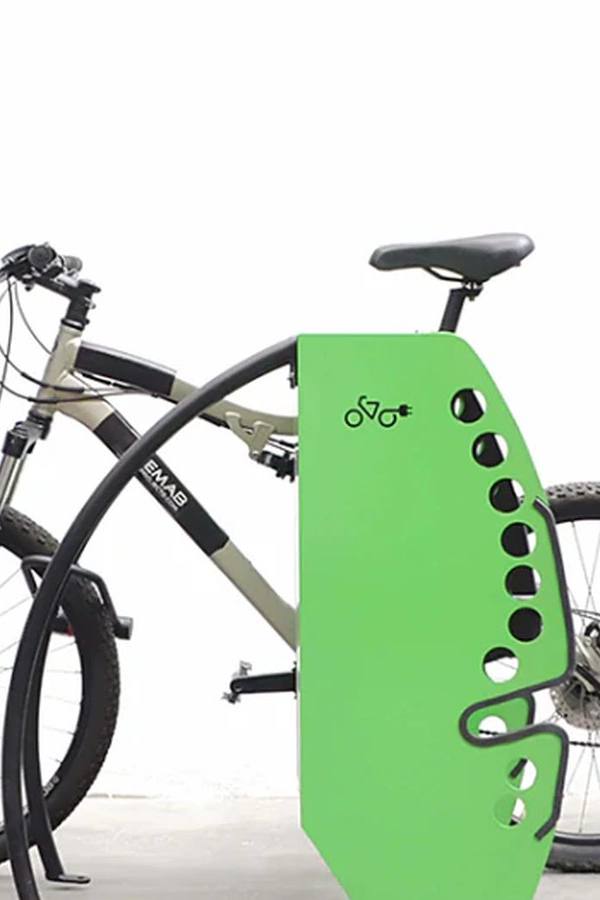
The simplest form, and often the best: a hoop that lets you lock frame and wheel at the same time. Robust, no moving parts, virtually maintenance-free and suitable for every type of bicycle, including cargo bikes and bikes with wide panniers.
Racks
Several bicycles per unit, at one or two heights. Efficient in terms of surface area, but the centre-to-centre spacing is decisive: too little space makes every second place unusable in practice.
Two-tier systems
Two levels stacked, with a gas- or spring-assisted upper rail. They double capacity per square metre and are justified where space is scarce, provided the mechanism stays operable for a heavy or electric bicycle.
Shelters and canopies
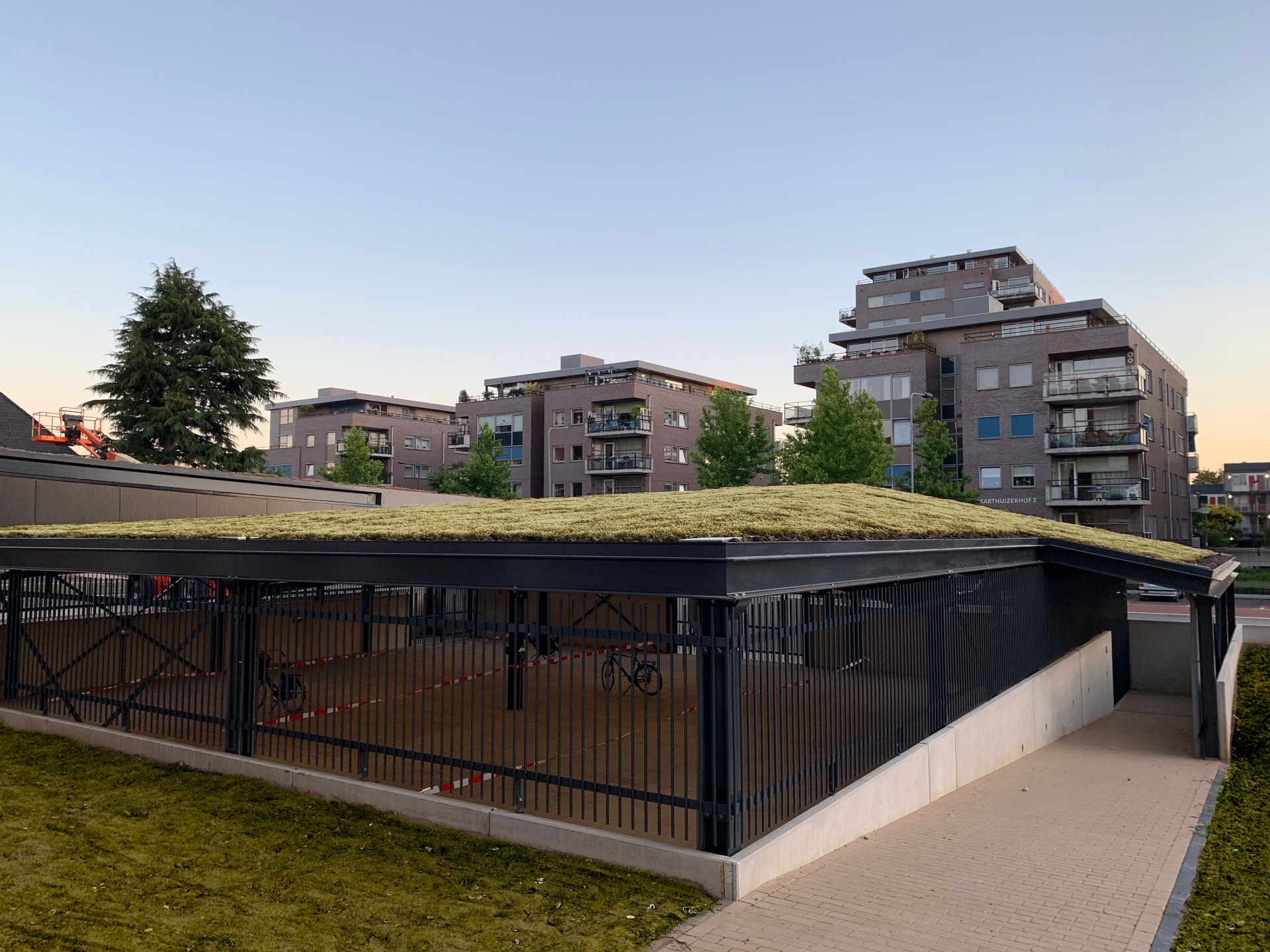
A roof over the parking, in steel, aluminium or timber, combined with glass, polycarbonate or a green roof. Increasingly supplemented with solar panels or lighting.
Lockers, boxes and bike garages
The most protective form, with individual or collective locking. See our dedicated page on bike lockers and garages.
Where to place it
Location matters more than the model. A few rules that hold up in practice: the parking should be closer to the entrance than the car park, visible from a busy route for social safety, reachable without having to dismount too early, and lit. A technically perfect shelter in the wrong place will stay empty.
For schools, allow for peaks: three hundred bicycles arrive within ten minutes. Aisle width and the number of access points matter more there than the rack model.
Mounting and ground conditions
Mounting depends on the substrate. On existing concrete or paving, chemical or mechanical anchoring usually suffices. On soft ground, concrete footings or a slab are needed. For shelters, wind load and snow load determine the foundation; we calculate these rather than estimate them.
We visit the site, take measurements, produce a layout plan and handle installation, including coordination with your contractor in the case of a redevelopment.
Materials, maintenance and service life
Hot-dip galvanised and powder-coated steel is the standard: strong, repairable and refurbishable after years of service. Aluminium does not corrode and keeps the structure light. Certified hardwood adds warmth but requires maintenance. Stainless steel is used where appearance is paramount or in coastal air.
Maintenance stays limited: check the anchors, repair the coating where damaged, clean the gutters on shelters. We supply spare parts and can take on maintenance.
Standards and points of attention
Several tender specifications refer to recommendations on centre spacing, bay length and aisle width. We test the design against these before submission, and tell you honestly when a requested number of places cannot be achieved in the available space without compromising usability. Eighty usable places beat a hundred of which half stay empty.
Frequently overlooked: room for cargo bikes and trailers, the width needed for panniers, and a power point if electric bicycles are to be charged.
What determines the price?
There is no fixed price per place, and an indicative figure would mislead you. The cost depends on:
- The number of places and the type of system: hoops, racks, two-tier or lockers.
- Whether it is covered, and the roof material.
- The choice of materials and level of finish.
- The existing ground and the foundation that follows from it.
- Additional technology: lighting, charging, solar panels, access control.
- Installation conditions: accessibility, phasing, working in a pedestrian zone.
Send us your plan and the number of places you need, and you will receive a detailed quotation in which every item is shown separately, together with our view on what is realistic in the space available.
Send us your site
Send a layout sketch or a few photographs, along with the number of bicycles and the type of user. We will produce a proposal with a plan, material choices and phasing.
Projects
All projects
Frequently asked questions
Hoeveel plaats heb ik nodig per fiets?
Fietsbeugel of fietsenrek — wat kies ik?
Zijn dubbellaagse rekken gebruiksvriendelijk?
Zijn er subsidies voor fietsenstallingen?
Further reading
Read our guide on when a covered bicycle shelter pays off.
Access to prices and ordering
Request access to our Herva-Doublet Platform. We review your request personally.