
Event and sports branding: what lasts beyond the day itself
Beachflags, boarding, sponsor banners and event furniture: what works on site, what works on camera, and how to reuse it next year.
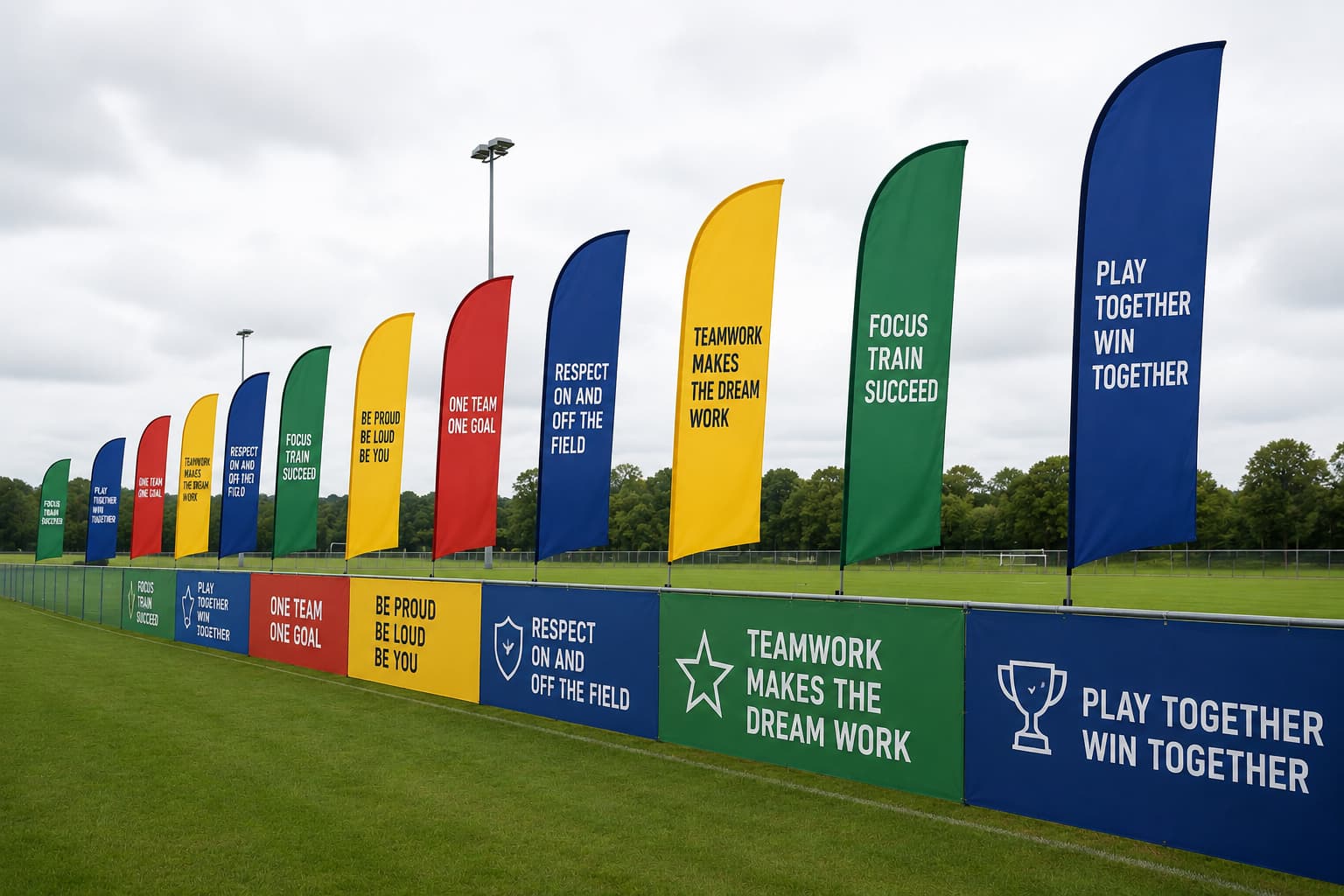
An event lasts a day. Its images keep circulating for years, in the club magazine, on social media, in the report to the sponsor, in next year's presentation.
That is the point most often missed in event branding. People think in terms of what the visitor sees on site, while the biggest return lies in what appears on camera — and those are not the same things. A banner at eye level works for the person standing there. For the photo of the finish or the prize-giving, only what hangs behind or above the action counts.
This article covers what works on site, what works on camera, how to serve sponsors properly, and how to make sure you do not have to reorder everything next year.
What works on site
Beachflags. The most demanding task of all event branding: making it visible from afar that something is happening here. They move, they stand high, and they work as a marker for a zone — registration, the start, the bar, the first-aid post.
Practical point that makes the difference: the base. On grass a ground peg works; on hardstanding you need a cross base with enough weight, and a base that is too light becomes a projectile at the first gust. Reckon deliberately generously here.
Boarding and fence sheets. Along a course, a pitch or an enclosure. This is the largest continuous surface you have at an event, and it is at the same time what appears in the competition images.
For outdoors the warning that applies everywhere with fabric holds: a closed sheet on a fence acts like a sail. For large lengths or on windy sites, choose a perforated version, or make sure the fence can take the forces.
Entrance branding. The gate, the registration zone, the first twenty metres. This is where the visitor decides what kind of event this is, and where most arrival photos are taken.
Wayfinding on site. Underestimated and time and again the biggest source of frustration: where are the toilets, where is the changing room, where do I report. A handful of clear signs at the decision points saves your volunteers hundreds of questions.
What works on camera
Think like a photographer before you order. There are only a few moments that get photographed, and they are known in advance: the start, the finish, the podium, the prize-giving, the group photo.
At each of those spots something ought to hang behind or above the action. A backdrop behind the podium, an arch or a banner above the finish, boarding behind where the winner stands. What hangs next to the action falls outside the frame.
Two practical rules. Repeat the logo several times across a wide surface instead of once large in the middle — on a cropped photo one then always remains visible. And mind the height: what hangs at knee level is covered by the people in front as soon as it gets busy.
Sponsors: the file that makes or breaks relationships
For clubs and organisers this is often the whole point of the branding. And it is exactly where it goes wrong when it has not been thought through in advance.
What helps.
Determine the levels in advance. Title sponsor, sponsors and partners each have their own place, size and visibility. Whoever fills that in only when the sheets have to be ordered ends up in a conversation nobody wants to have.
Limit the number of names per surface. The same rule as with a multi-tenant totem: every extra name shrinks all the others, and beyond a certain point nobody is legible. Better five legible logos on boarding than twelve that are unrecognisable in a photo.
Think about the evidence. A sponsor wants to know afterwards what it has yielded. Photos on which its logo is clearly legible are the concrete proof. That argues for concentrating the sponsor branding on the spots that will certainly be photographed, rather than spreading it evenly across the site.
Provide for swappability. Sponsors come and go. A system in which the sheet changes while the structure stays means a new sponsor does not require a new investment.
Furniture and the zones where people linger
Branding is not only fabric. Where people wait, queue or linger, furniture is what makes the place.
Poseur tables with printed covers in the catering zone, a branded reception desk at registration, seating in a zone where people wait, and printed barriers that at the same time steer the flow of movement. These elements do double duty: they solve a practical problem and carry the brand.
For the reception zone, moreover, something holds that is often forgotten at sports events: this is the spot where volunteers and visitors meet and where the first impression is made. A makeshift table with a cardboard sign on it says something different from a well-kept desk.
Next year: reuse as the starting point
The most expensive thing about event branding is not the material but the repetition. Whoever reorders everything every year because a year was printed on it or because the material was stored wrongly pays a multiple.
Three decisions that prevent it.
Do not put a year on what you want to reuse. Dates belong on one separate element — a loose sheet, a banner at the entrance — and not on the boarding, the beachflags and the backdrop. That one element you replace each year; the rest you do not.
Separate structure and image. Frames, bases, masts and fences stay; sheets and banners change. From the second edition onwards you come out cheaper.
Store it correctly. This is the reason material succumbs, not use. Never store damp fabric — a sheet folded wet and left for weeks comes out with stains that will not go away. Roll beachflag sheets instead of folding them, because crease lines stay visible. And keep the bases, pegs and ratchet straps with the material itself.
An inventory with photos of what you have and where it lies is, for associations with changing volunteers, often the most useful investment of all.
Practical points of attention
Fire safety. On trade-fair grounds, in sports halls and in tents with the public, requirements for the fire behaviour of fabric apply, and that is checked on site. Ask for the fire-class certificate before you order.
Public land. For temporary structures and advertising on public land, municipal conditions apply, often with a maximum duration and rules about placement relative to the road.
Set-up time and volunteers. Material that can be set up by two people without tools gets set up. Material that requires a manual ends up crooked or stays in the van.
Why the price differs so much
The scope. The number of elements and the total running metres of boarding are the biggest factors.
The material and the print. UV-resistant ink, perforated or closed fabric, and the edge finish determine whether it is still usable next year.
Structures and bases. Beachflag bases, frames and fences are a one-off investment you carry for years.
The degree of custom work. Standard sizes sit in a different order from a backdrop made to measure for a stage.
Furniture. Poseur tables, desks and seating, branded or neutral.
Set-up and take-down. Done yourself or by our crews, and whether that happens within or outside normal hours.
That is why we work with a proposal tailored to your event instead of a rate per element. The concrete figures are in the Herva-Doublet Platform.
From running order to site
The most useful first step: send us a plan or an aerial photo of the site with the zones on it — start, finish, podium, reception, catering — and the number of sponsors with their level. From that follows naturally what goes where and what is reusable each year.
Beachflags, boarding, tents, flags, signage and reception and event furniture come from us in one hand, from design through production to set-up. One point of contact, one brand identity — and a site that still looks good in next year's photos.
Frequently asked questions
Further reading
Related articles
Ready to take the next step?
Request a 3D design or an advisory meeting, or request access to prices in the Herva-Doublet Platform.