
Banners and fabric frames: when to choose which
Banner or frame, indoors or out? Materials, wind load, fire safety, interchangeability and why the price differs so much.
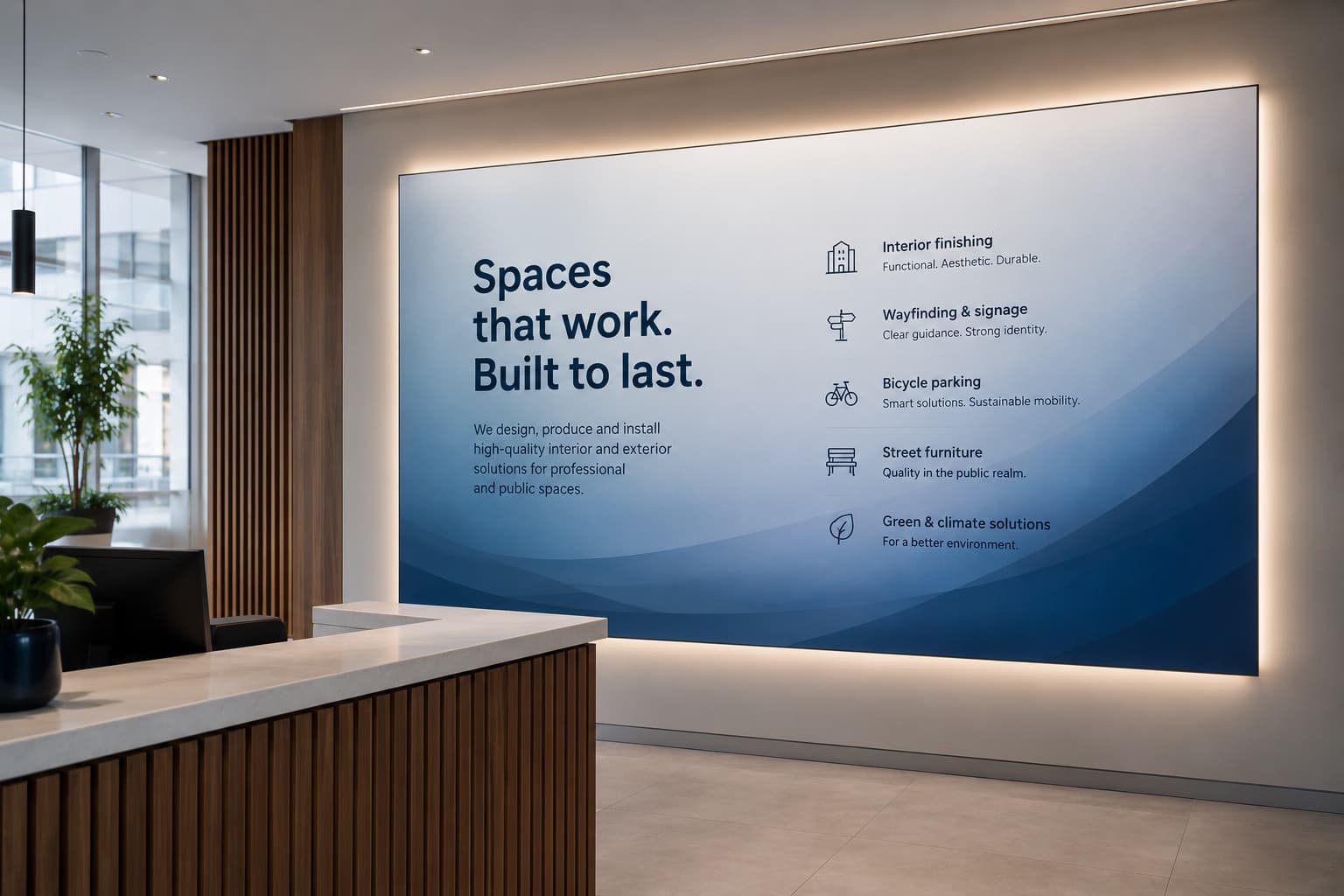
Fabric is the most underestimated material in visual communication. It is light, it can be large without the weight getting out of hand, it is quick to replace, and it costs a fraction of a fixed construction.
But there is a difference between a banner and a fabric frame that goes further than price, and that difference determines whether your message will still look well-kept in a year's time. A banner is a fabric you tension with eyelets and tensioners. A fabric frame is a profile into which a fabric with a silicone edge clicks snugly into a groove, so the image stays flat and the edge falls away invisibly.
This article covers when to choose which, what you need to know about wind, fire safety and lifespan, and why the price differs so much.
Banners: large, temporary and affordable
A banner is the logical choice when the size is large, the message temporary, and the installation needs to stay straightforward.
Classic applications: a site banner on a hoarding or scaffold, a facade banner for an opening or promotion, sponsorship banners along a sports ground, an announcement on a municipal building.
What makes or breaks a banner is the tension. A fabric that hangs too loose looks cheap, however good the print is — and it flaps against its surface in the wind, which wears it out faster. Enough fixing points and tensioners you can re-tension are therefore not an extra but a basic requirement. Allow a fixing point every fifty to seventy centimetres along the edges; for larger banners there should also be fixing in the middle.
For outdoors there is also one thing often forgotten: wind. A closed fabric on a hoarding or scaffold acts like a sail. For large surfaces you therefore choose a perforated version that lets wind through, or you accept that the structure underneath must be able to bear the forces. We have too often seen a beautiful banner pull a hoarding over in the first autumn storm.
Fabric frames: taut, interchangeable and mainly indoors
A fabric frame gives a very different impression. The fabric sits taut in a profile, there are no visible eyelets or tensioners, and the edge of the frame is narrow — so the image runs all the way to the edge.
Two properties make it especially valuable.
The image is interchangeable. The fabric clicks out of the groove and another goes in. The frame stays in place. For a showroom, a shop or a reception area where the image changes per season or campaign, that is the difference between ordering a new panel every time and ordering only a fabric every time.
It can be illuminated. A frame with a light box behind it turns the fabric into a light panel. That is the modern successor to the classic light box: just as eye-catching, much flatter, and with an image you can replace yourself. For retail, hospitality and reception areas this is often the strongest option.
Fabric frames are primarily an indoor product. Outdoor versions exist, but the fabric and profiles must then be explicitly made for it — hanging an indoor frame outside is a classic mistake that lasts one season.
How to choose
Four questions usually get you to the answer.
How long does it need to hang? A few weeks to a season: banner. Years, with changing imagery: frame.
Indoors or outdoors? Outdoors the banner wins on practical grounds, unless you take an explicit outdoor version of a frame.
Does the image change? If so, a frame pays for itself from the second or third swap, because you only replace the fabric.
How polished does it need to look? A frame looks considerably more premium. In a reception area or showroom that is the argument that tips the balance.
Material and print
For outdoor fabrics the common base is a plastic-coated woven material: strong, waterproof and easy to print on. For large facades or hoardings there is a perforated variant that lets wind through — it costs a little in image quality but gains in safety.
For fabric frames you use a woven polyester fabric with a silicone edge that clicks into the groove. The fabric is light, foldable and therefore cheap to ship — a real advantage when you send images to multiple branches: you post an envelope instead of transporting a panel.
Two points determine the quality. The ink and the printing process: for outdoors you need a UV-resistant version, otherwise the red shifts visibly within a year. And the edge finishing on banners: a hemmed edge with reinforcement at the eyelets is exactly where cheap banners cut corners, and it is the place where they always tear.
Fire safety: the point that hurts afterwards
This is systematically overlooked with fabric, and it is exactly where a project can run aground.
In public buildings, shops, schools, care facilities, sports halls and at trade fairs, requirements apply to the fire behaviour of materials hanging on walls and ceilings. Fabric falls under them. Exhibition halls and event venues moreover often apply their own regulations, and these are checked on site.
Therefore always request the fire class certificate before you order, and compare it to the requirements of your building or the venue where it will hang. A beautiful banner refused on the day of assembly is a problem you could have avoided with a single question in advance.
Lifespan, maintenance and storage
Outdoor fabrics last a long time when they hang correctly tensioned and when the print is UV-resistant. What ends the lifespan in practice is rarely the material: it is the eyelets tearing out because the fabric hung too loose, or the colour shifting because no UV-resistant ink was used.
Indoor fabrics in a frame last for years and can usually be washed — but do ask for the washing instructions, as this differs per fabric type.
For both: store the fabrics you are not temporarily using correctly. Folded in a dry space, not rolled up in a damp cellar. And keep the print file with its specifications, so a re-order is identical and not slightly off in colour.
Why the price differs so much
Fabric or frame. A banner and a fabric frame are in a different order of magnitude, and the frame is immediately an investment in a system rather than in a single image.
The size. Larger costs more, but for banners the price per square metre falls as the fabric gets bigger.
The material and the print. UV-resistant ink, perforated or closed, and the edge finishing determine the lifespan.
Lighting or not. For frames this is the biggest single factor after size.
The installation. Hanging on a hoarding is different from mounting a frame on a wall or installing a light box with a power supply.
The quantity. Multiple branches with the same frame and different fabrics work out cheaper per unit than a single one-off.
That is why we work with a bespoke proposal rather than a rate per square metre. The actual figures are in the Herva-Doublet Platform.
One image across branches and campaigns
Those who work with multiple branches or changing campaigns benefit more from a system than from one-off orders. A set of frames in fixed places, and per campaign a series of fabrics you send out: that is manageable, recognisable and cheaper per swap than new panels each time.
Fabrics, frames, facade signage, vinyl graphics and wayfinding come from us in one hand, from design through production to installation. One point of contact, one brand identity, and a campaign that looks the same in every branch.
Frequently asked questions
Further reading
Related articles
Ready to take the next step?
Request a 3D design or an advisory meeting, or request access to prices in the Herva-Doublet Platform.