Event tents and canopies: choosing without surprises
Which tent suits your event? Types, anchoring and wind safety, ground conditions, branding, hire or buy and why the price differs.
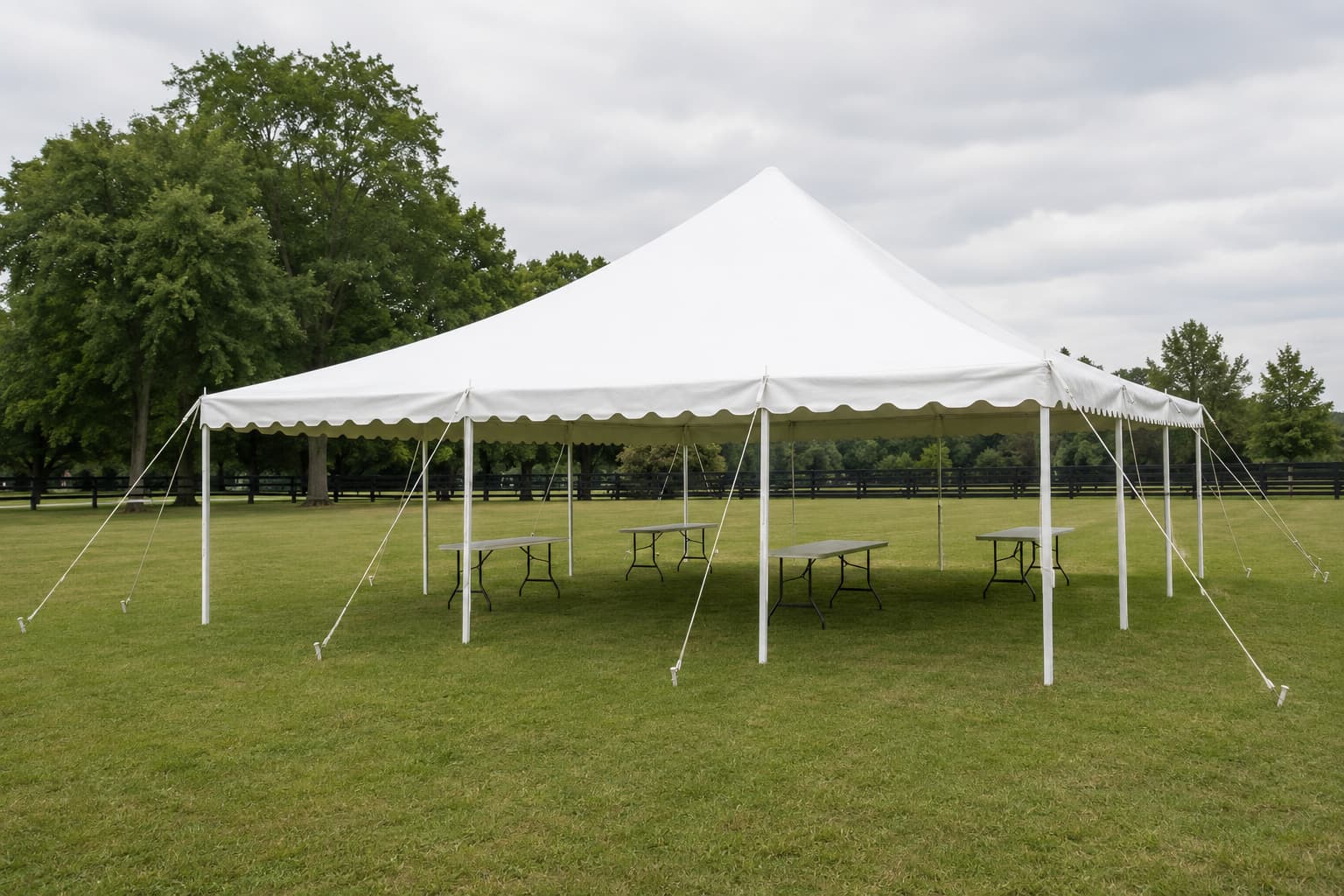
There is one thing at events that nearly always goes right and one thing that can nearly always go wrong, and it is not what people think. The set-up usually goes smoothly. What goes wrong, goes wrong with the wind — and then it goes quickly and seriously.
A tent is in fact the only element on an event site that presents a large surface to the wind while at the same time being full of people. That makes the choice between types, and especially the anchoring, not a practical matter but a safety matter.
This article covers which tent suits which use, what you need to know about anchoring and ground, how to handle branding, when hiring is better than buying, and why the price differs so much.
The types at a glance
Folding tents. A frame that opens out like scissors, with a roof attached to it. Set up in a few minutes by two people, and just as quickly packed away afterwards.
This is the workhorse for market stalls, stands at a neighbourhood party, first-aid posts along a route and outdoor company activities. The quality differences here are large and not always visible at purchase: the hinge work and the thickness of the profiles determine whether the tent still stands straight after being set up twenty times.
Important: a folding tent is intended for short-term use under favourable conditions. It is not a structure to leave standing for days without supervision.
Frame tents and modular systems. An assembled frame with separate roof and wall sheets. Heavier to put up, but considerably sturdier, and expandable in modules so you can adjust the length to the event.
This is the choice for a multi-day event, a tent that has to receive the public, or a set-up that stays in place for several days.
Folding or fixed canopies without walls. For a terrace, an entrance zone, a stage canopy or a shaded area. Here it is not about enclosing but about shelter, and the structure may be lighter — with the same warning about wind.
Permanent canopies. When the same spot needs shelter every year or every weekend — a terrace, an outdoor classroom, a stand zone — a fixed structure works out cheaper and safer in the long run than rebuilding each time. That is then no longer event equipment but construction work, with a permit and foundations.
Wind: the reason this is a safety file
Every tent has a limit to what it can take, and that limit ought to be in the documentation. Ask for it, and set it against the weather forecast.
Three principles that make the difference in practice.
A tent with closed walls catches far more wind than a tent with open sides. That is counter-intuitive — people close the walls just when it starts to blow — but a closed tent acts like a sail that pushes on every side. As the wind picks up, opening the walls on the windward side is often the most sensible thing you can do.
Anchoring is not an option. A tent that stands on weight on its feet instead of being anchored moves in a gust — weight and all. Ballast is a solution when anchoring is not possible, but the weight then has to be proportionate to the surface, and that is almost always more than people estimate.
Someone has to be responsible. At a multi-day event, one person must follow the weather forecast and have the authority to decide that the tent is cleared or taken down. Without that agreement in advance, that decision is taken too late.
For events on public land, the municipality or the fire service often requires documentation about the structure and the anchoring. That is not a formality you sort out the day before.
The ground determines how you anchor
On grass or soft ground you work with pegs or ground anchors, and then the soil condition matters: in dry, hard summer ground or in saturated wet ground, anchors hold less well than in normal conditions.
On hardstanding — concrete, tarmac, paving — you usually cannot anchor without damage, and then you work with ballast. Reckon generously here: the weight needed is systematically underestimated, and too little ballast is more dangerous than no tent at all.
Two practical points that are often forgotten. Underground pipes: driving ground anchors in a park zone or on a square is not an action to do without prior checks. And water drainage: a roof catches water, and where it ends up determines whether the area around the tent stays passable or becomes a mud pool. For larger set-ups, that is a design question, not a detail.
Branding: from a neutral tent to a recognisable spot
A white tent is a white tent. What is visible of your organisation determines whether the event yields anything beyond the day itself.
What works.
The roof and the canopy. From a distance and from above — think of photos and drone shots — the roof is the largest visible surface. In many set-ups, it is the only thing that is legible from afar.
The side walls. Up close and at eye level, and so what the visitor reads while queuing up.
What stands around it. Beachflags, flags at the entrance, sponsor banners along a fence and printed table covers together often make more of an impression than the tent itself. A neutral tent within a well-branded whole looks more cared for than a printed tent among loose elements.
What you decide in advance: do you go for a printed tent that only works for you, or for a neutral tent with swappable sheets and banners? The second is almost always wiser when you do several events, or when sponsors change.
Hire or buy
A simple guideline, with the nuance alongside.
Hiring pays off for a few times a year, for a size you rarely need, or when you do not want to organise the set-up and storage yourself. You pay more per time, but you have no storage, no maintenance and no responsibility for the condition of the material.
Buying pays off from a certain frequency — in practice a few times a year, every year again — and especially when the tent is branded and therefore not interchangeable with hire material anyway.
What people forget to include when buying: the storage space, the transport, the maintenance, and the realisation that a tent stored wrongly — damp — has mould stains after one winter that will not come out. Include that cost, and the comparison turns out fair.
Maintenance, storage and lifespan
What ends the lifespan of tent material is rarely use. It is storage.
The rule is simple and almost always broken: never store damp fabric. A sheet folded wet and left in a crate for three weeks comes out with stains that will not go away, and in time with a weakened weave. For an event broken down in the rain, that means: hanging the fabric out somewhere later to dry, even if that is the last thing anyone wants to do at that moment.
Furthermore: check the frame periodically for deformation and for hinges that no longer run smoothly, and keep the spare material — ratchet straps, pegs, ballast elements — with the tent and not somewhere else.
Permit and safety
For temporary structures on public land, municipal conditions apply, and they differ greatly. Documentation is often requested about the structure, the anchoring and the fire behaviour of the fabric.
That last point regularly causes problems at events: fabric hanging in public buildings, tents with the public and on trade-fair grounds must meet requirements for fire behaviour, and that is checked on site. Ask for the fire-class certificate before you buy or hire.
Reckon on this having to be sorted out early. We include these questions in the file as standard.
Why the price differs so much
The type and the structure. A folding tent, a frame tent and a permanent canopy sit in entirely different orders of magnitude.
The dimensions. More surface means more frame and more fabric, and for larger spans a heavier structure.
The quality of frame and fabric. This is where it is determined whether the tent still stands straight after being set up twenty times, and this is where cheap quotes cut corners.
Branding. Printed roof, printed walls, or neutral with separate sheets — each a different cost and a different flexibility.
Anchoring and ballast. Location-dependent and dependent on the ground.
Set-up and take-down. Done yourself or by our crews, and whether that happens within or outside normal hours.
That is why we work with a proposal tailored to your event instead of a rate per square metre. The concrete figures are in the Herva-Doublet Platform.
From site to running order
The most useful first step: send us the location and the ground, the number of days, the expected number of visitors and what needs to happen under the tent. From that follows which type fits and what the anchoring requires.
Tents and canopies, flags, banners, beachflags, signage and reception furniture come from us in one hand, from design through production to set-up. One point of contact, one brand identity — and a site that looks like one whole instead of a collection of loose elements.
Frequently asked questions
Further reading
Related articles
Ready to take the next step?
Request a 3D design or an advisory meeting, or request access to prices in the Herva-Doublet Platform.