
Sustainable street furniture: how do you spot a bench that lasts 20 years?
Recycled plastic, FSC wood and powder-coated steel — what actually works in Belgian weather, and what to specify in the tender?
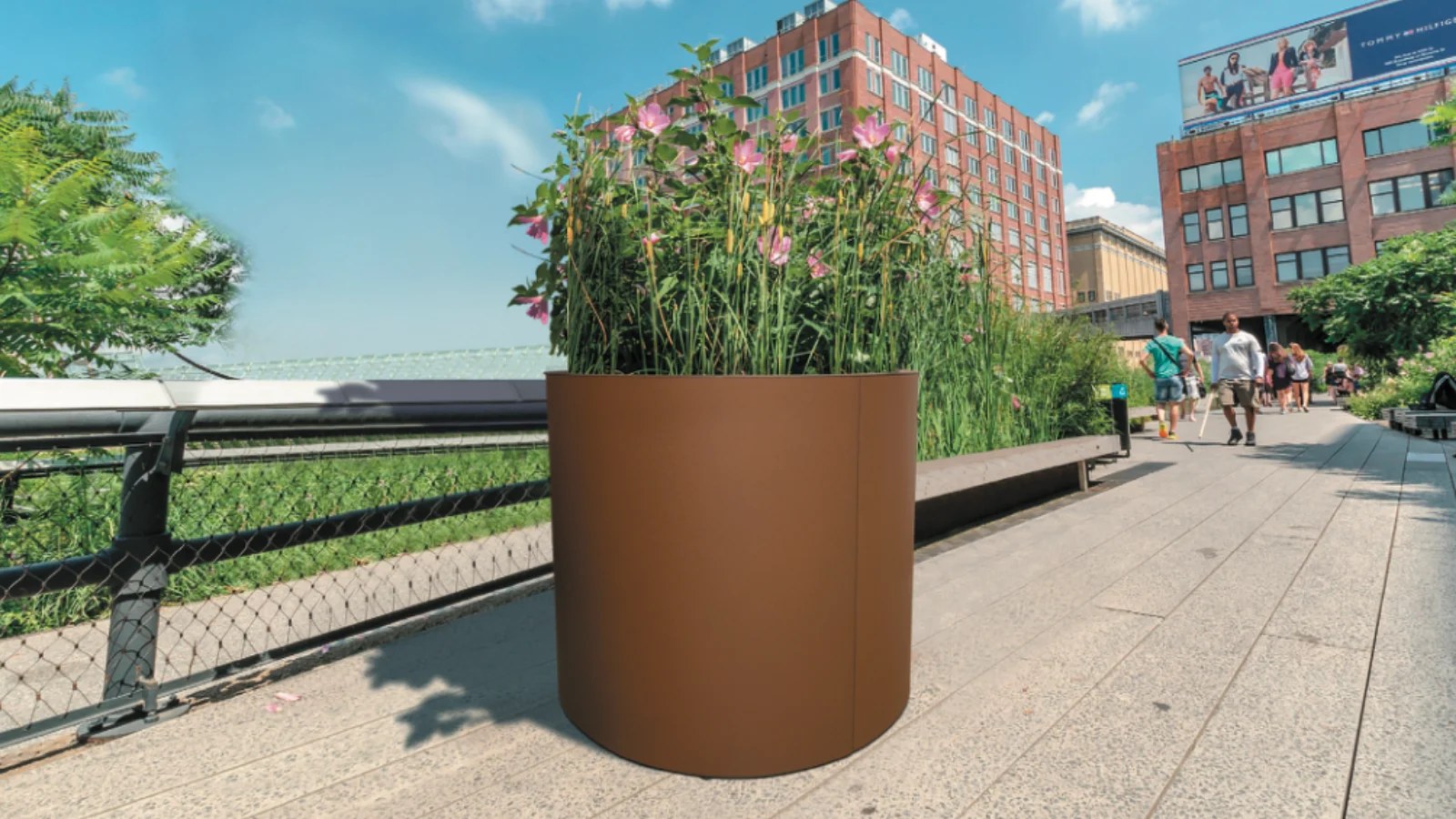
Every municipality knows them: benches rotting after 5 years, bins rusting at the base, planters cracking with frost. Choosing durable street furniture is less about price and more about material, anchoring and detail. Three principles make the difference.
Material: choose deliberately, not by default
Recycled plastic (100 % recycled HDPE slat profiles) offers the longest life in the public realm: no rot, no varnish, colour-stable for up to 20 years. FSC-certified hardwood feels warmer and suits historic centres, but needs an oil treatment every 5 years. Powder-coated steel is ideal for the structure — but always hot-dip galvanised before powder coating, or the coating will fail around the welds.
Anchoring: the invisible difference
A good bench stands or falls at its foot. Use below-ground anchoring (set in concrete) rather than surface bolts — it resists vandalism and snow ploughs alike. Add a stainless drain at the bottom of hollow profiles so rainwater doesn't collect.
Material choice usually gets the most attention in a tender, and anchoring the least. In the field it is the other way round: most premature replacements we see are not about rotten wood or faded plastic, but about furniture that has come loose, subsided or been moved.
The surface determines the approach. On existing concrete, fixing can usually be done directly, which is the most stable. With paving stones or slabs, the fixing must go through the surfacing into a load-bearing layer, otherwise movement occurs as soon as the furniture is intensively used. In a green space or on loose ground, a foundation is needed, and that is exactly the item most often underestimated at first estimate.
A second point that is often forgotten: underground pipes and utilities. Excavation in the public realm requires a prior check of what is in the ground, and that is decisive for the planning.
And a third: water drainage. Furniture standing in a hollow where water collects ages faster than the same furniture ten metres further along. For wooden versions, the underside of the slats and the connection to the structure are where it always starts.
Detail: what makes maintenance realistic
The most sustainable bin is the one whose inner liner swaps out in 5 seconds. When buying, ask for the maintenance scenario: how the bag is changed, how the bin is cleaned, which spare parts are available for 10 years. If the supplier can't answer — choose another.
In the tender: specify outcomes, not brands
Avoid brand-locked specs. Write outcome-based requirements instead: "minimum 15-year life under normal use", "colour fastness ≥ 6 on the blue-wool scale", "maintenance limited to yearly cleaning". You'll get comparable quotes and shield yourself from cheap knock-offs.
Green statement
We are ISO 14001 certified and produce our street furniture range from recycled materials wherever possible, with an end-of-life take-back guarantee. This isn't greenwashing — it's the standard Belgian cities are entitled to demand today.
Comfort determines whether it is used
A bench that nobody uses is neither durable nor useful. Yet comfort is rarely specified in tenders, even though it determines whether the investment pays off.
A few points that make the difference in practice. A backrest makes a bench usable for anyone who wants to sit for more than a few minutes — without a backrest, an older visitor will not use the bench. Armrests help with sitting down and getting up, which for a significant proportion of users is the difference between usable and unusable. And the seat height matters: too low makes getting up difficult, too high leaves the feet dangling.
Think also about placement. A bench in full sun without any shade stays empty in summer; a bench with its back to a busy road is avoided. Seating works best where there is something to see and where people do not feel exposed.
For an ageing population there is a further argument: regularly distributed seating increases the distance people can manage on foot. A series of benches along a walking route is therefore not decoration but a mobility measure.
Vandalism and maintenance
Fully vandalism-proof furniture does not exist, but the difference between versions is great — and lies mainly in the details.
Fixings that cannot be undone without tools prevent the easiest vandalism. Closed profiles and flat surfaces without cavities give less grip for waste and fewer leverage points. And surfaces from which graffiti can be removed without damaging the finish save more in the long run than they cost at purchase.
Maintenance itself remains limited with a solid version: periodic cleaning, checking the fixings and, for wooden versions, keeping to the agreed maintenance schedule. The latter is a real cost that belongs in the comparison. A wooden bench that looks nicer but needs treatment every few years can work out more expensive over fifteen years than a low-maintenance version that cost more at purchase.
Circularity: what you can ask for in a tender
Sustainability requirements appear increasingly in tenders, but often remain stuck on a general formulation that anyone can fill in as they see fit. If you genuinely want to steer, these are the questions that yield something.
Ask for the share of recycled material, expressed as a percentage rather than the word "recycled". Ask whether parts are individually replaceable: a bench on which you can replace one damaged slat lasts considerably longer than one you have to dispose of in its entirety. Ask about the long-term availability of parts, because replaceability is theoretical if the part no longer exists in eight years' time. And ask whether the furniture is, at the end of its life, demountable and separable by material stream.
Those four questions together say more about the real environmental impact than a certification mark on a product sheet.
Coherence in the streetscape
Street furniture is rarely bought in a single purchase. A council tops up as the budget allows, and the result is a streetscape in which every purchase round is visible: three kinds of benches, four kinds of bins, two shades of grey.
That is more than an aesthetic problem. A consistent streetscape reads as cared for and managed, and well-kept places are demonstrably better treated than places that look neglected.
So fix a line early — material, colour, formal language — and keep to it across the purchase rounds. We are happy to think along, even when the file is not yet on the market. Street furniture, cycle parking, wayfinding and branding come from a single hand with us, so that the public realm feels as though it was meant that way rather than being a collection of separate purchases.
Why the price varies so much
The material and the execution, the surface treatment, the extent to which parts are replaceable, the surface and the anchoring, the number of units and their spread across the municipality, and the installation conditions: those factors together explain why two councils with the same request get very different quotes.
That is why we work with a bespoke proposal rather than a catalogue rate. The concrete amounts can be found on the Herva-Doublet Platform.
Frequently asked questions
Further reading
Related articles
Ready to take the next step?
Request a 3D design or an advisory meeting, or request access to prices in the Herva-Doublet Platform.