Covered bicycle shelter: when is a roof worth it?
When does a roof on your bicycle shelter pay off? Types, space, permits and why the price differs from project to project.
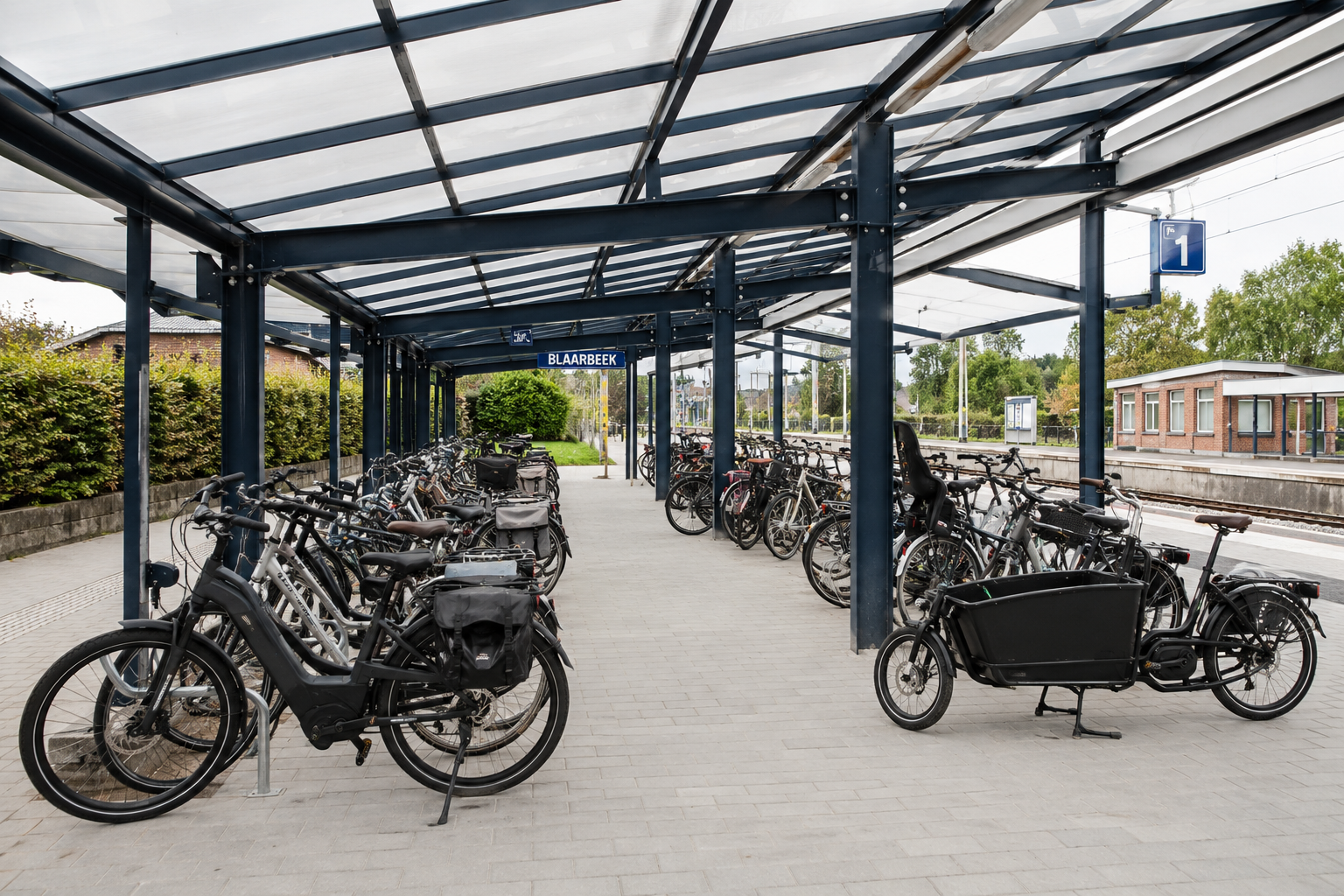
Installing a bicycle shelter is one decision. Adding a roof is a second — and that second one is postponed more often than it is taken. Understandably: a canopy raises the investment, requires more space and sometimes a permit. Why would you do it if the bikes stand just as well without?
Because the answer depends on one question that is rarely asked: how long do those bikes stay there?
For short-stay parking in a shopping street or a square, open stands are more than enough. Someone parks a bike, runs an errand and leaves within half an hour. Rain is then an inconvenience, not a problem. But as soon as bikes stand there for hours or days — at a station, a school, a business site or a neighbourhood without its own storage — the calculation changes completely. A roof then protects not only the bikes, but also the structure itself, and it changes the way people use the spot.
In this article we set out when a canopy pays off, which types exist, what to watch for in terms of space and permits, and why the price differs from project to project.
When a roof pays off — and when it doesn't
There is no general rule, but there is a usable rule of thumb: the longer the average parking time, the stronger the case for a canopy.
Stations and mobility hubs. Bikes stand here for a full working day, often longer. Someone who leaves in dry weather in the morning and returns in the rain in the evening gets on a wet saddle. That is precisely the kind of annoyance that, after a few times, makes people decide to take the car after all. A canopy is not a comfort detail here but a condition for sustaining cycling.
Schools and campuses. Pupils and students leave their bikes for six to eight hours. Moreover, the bike fleet there is young and intensively used — protecting it from the weather noticeably extends its lifespan. And there is a practical point: wet bikes mean wet clothes in class.
Business sites and offices. Anyone who wants to encourage cycling among staff must make it more attractive than the car. A dry bike on the way home is a stronger argument than most communication campaigns. In addition: at businesses, the shelter also serves as a calling card for visitors.
Neighbourhoods without bike storage. In densely built streets where residents have no space of their own, the bike stands outside permanently. Without protection, a bike there is worn out by rust and UV damage within a few years.
Where open stands are enough
Short-stay parking in the streetscape. Shopping streets, squares, stops, the entrance of a public building. What counts here above all is findability, visibility and the possibility of fixing the frame. A roof adds little and can even make the streetscape heavier than intended.
Locations with limited height or sightlines. Sometimes a canopy is not desirable from a planning point of view — for example for a protected facade or in a place where the view must stay open. A well-executed open layout is then the better choice.
Temporary setups. On a building site, an event or a trial setup, the investment in a roof rarely weighs up against the usage period.
What a canopy actually does
Most people think of dry bikes first when they think of a roof. That is the most visible effect, but not the most important one.
It extends the life of the structure itself. A bicycle shelter stands outside permanently and has to deal with rain, frost, UV and, in winter, road salt. Under a roof the surface treatment stays intact for years longer, which means you have less touching up or replacing to do later. Looked at over fifteen years, that is often the largest part of the return.
It protects the parked bikes. Electric bikes are especially sensitive here: the electronics, the connections and the battery are better off under a roof. As e-bikes make up an ever-larger share of the fleet, this argument carries more weight than a few years ago.
It makes the spot recognisable. A canopy gives a bike parking spot visual presence. People find it faster, use it more consistently and park beside it less often. That last point is an underrated effect: a shelter that is read as "the spot" keeps the streetscape tidy.
It opens up extra possibilities. A roof is a load-bearing structure. Lighting, wayfinding, solar panels or a green roof can be attached to it. Lighting raises social safety and with it winter use; solar panels and green roofs tie in with sustainability goals that are increasingly demanded explicitly in tenders.
The canopy types at a glance
Canopies differ strongly in form, material and construction. These are the main outlines.
Single-sided canopy. A roof supported on one side, usually above a single row of bikes against a wall or at the edge of a site. Compact, relatively easy to install and suited to limited space. Ideal along a facade or a wall.
Free-standing canopy. Supported on both sides or on columns, allowing bikes to be parked on either side. More efficient in space per bike, but requires more open surface and a sturdier foundation.
Continuous or modular systems. Built from segments placed side by side. The great advantage is extendability: start with forty spaces and you can extend later without replacing everything. For municipalities working in phases within a multi-year plan, that is often decisive.
Closed and semi-closed constructions. With side or rear walls, which strongly increases protection against driving rain and wind. They also give a sense of enclosure, which raises theft comfort. The downside is less overview — important for social safety, so it requires attention to lighting and sightlines.
Canopy with integrated functions. Lighting, solar panels, green roof, charging points for electric bikes or digital information panels. These combinations are gaining importance: they let one intervention serve several goals, from mobility to climate.
Space, height and accessibility
A canopy that fits on paper but hinders in practice will not be used. A few points of attention.
Clear height. Enough height is needed to manoeuvre comfortably under the roof with a bike in hand — certainly with a cargo bike, a bike with a child seat or a bike with panniers. Aiming too low saves on the structure but costs usage.
Space around the shelter. Beside the parking spaces themselves you need manoeuvring room: an aisle where people can pass each other with a bike in hand. If that is dimensioned too tightly, the hardest-to-reach places stay structurally empty.
Step-free access. Level access without steps makes the difference, certainly for heavier e-bikes and cargo bikes. Here too, what is awkward is avoided.
Drainage. A roof catches water and it has to go somewhere. Where the rainwater ends up determines whether the area beneath stays dry or becomes a puddle. For larger canopies this is a design question, not a detail.
Permits and regulation
In Belgium, canopies are subject to municipal planning rules that vary from one municipality to the next. Depending on the dimensions, the location and the zone, an environmental permit may be required, or a notification may suffice. Different conditions apply on private land than in the public domain, and requirements are stricter in a protected townscape or village scene.
That sounds more complicated than it usually is, but it is something to find out early in the process rather than afterwards. We include the question in the file as standard: which procedure applies, what has to be supplied and how long it realistically takes. That way the permit does not suddenly end up on the critical path.
Material, finish and maintenance
A canopy stands outside permanently. The material choice and above all the surface treatment determine how it ages.
For the load-bearing structure, a weather-resistant construction with a sound treatment is essential: it must withstand rain, frost, UV and road salt for years without rusting or discolouring. For the roof covering, several options exist, from fully closed panels to translucent variants. The latter is more than an aesthetic choice: translucent roof covering keeps the space below brighter, which benefits social safety and increases use in the dark months.
As for maintenance: a correctly executed canopy needs little more than periodic cleaning and a check of the fixings. Most maintenance problems we encounter do not stem from wear but from too light an execution at the outset — saved on the treatment, and then touching up every year.
Why the price differs from project to project
This is the question that almost always comes first, and the honest answer is that there is no catalogue price. Two municipalities each asking for a covered shelter for forty bikes can receive a very different quote — and rightly so.
The type of parking system beneath. Simple leaning stands fall in a different order of magnitude than a two-tier system. The roof is one component; what stands beneath often weighs more heavily in the price.
The dimensions and capacity. More places means more construction, but not linearly: for larger canopies the cost per bike space generally decreases.
The construction and finish. The choice of material, the surface treatment, the type of roof covering and the level of finish make a considerable difference — and are precisely what determines how long the installation lasts.
The subsurface and foundation. A canopy on existing concrete asks something quite different from one that has to be fully founded. This is the factor most often underestimated in a first estimate.
Integrated functions. Lighting, solar panels, a green roof or charging points each add their own cost — but also each serve their own goal.
Installation, transport and tender requirements. Accessibility of the location, the schedule and specific requirements from a tender all weigh in on the final price.
That is why we work with a proposal tailored to your situation rather than a catalogue rate. That way you pay for what you actually need — not too much for superfluous extras, and not too little for a structure that will not last. The concrete amounts are available in the Herva-Doublet Platform.
From enquiry to proposal
Do you have a picture of the location, the desired number of spaces and the length of use? Then the step to a concrete proposal is small. Send us the basics — location, number of spaces, subsurface and any tender requirements — and we will work out a proposal, from advice on the right system through to installation.
As a partner in visual communication for the public realm, we look beyond the shelter alone. Bicycle parking, wayfinding, street furniture and branding all come from one hand, so the whole hangs together instead of being a collection of separate elements. We make you stand out — also with a bicycle shelter that is right.
Frequently asked questions
Further reading
Related articles
Ready to take the next step?
Request a 3D design or an advisory meeting, or request access to prices in the Herva-Doublet Platform.