
Acoustic wall panels: material, mounting and lifespan
Which acoustic panel suits your space? Materials, absorption classes, mounting, fire safety and why the price differs.
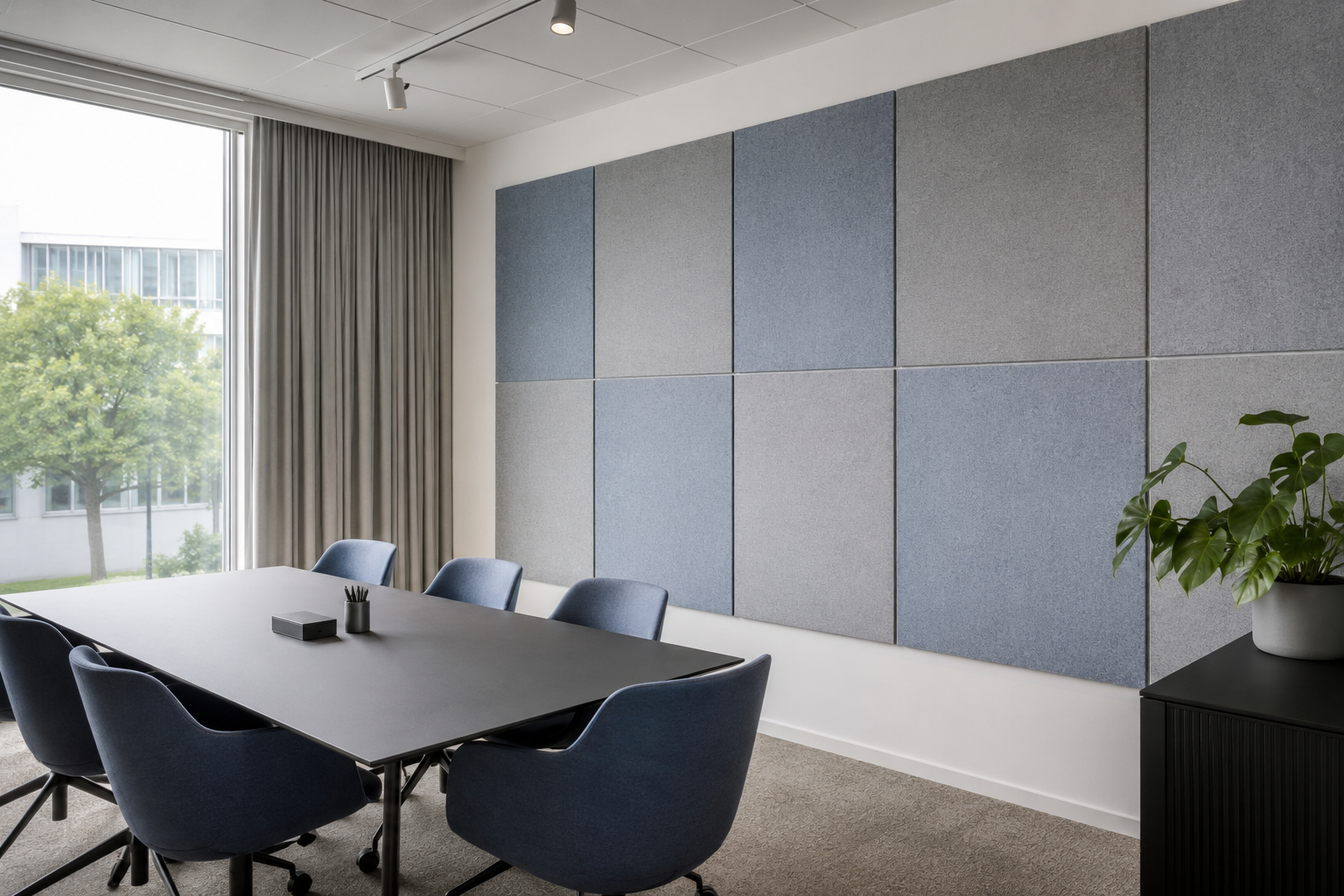
You have established that it is too noisy. The meeting room echoes, in the open-plan office nobody can understand each other on the phone, and people are starting to work from home because it does not work at the office. The decision to do something about it has been taken.
Then comes the next question, and it is more technical than it seems: which panel, in which material, mounted how and how many?
You will rarely get a usable answer to that question online, because most information comes from parties who sell one material and therefore present that material as the best. This article tries to do it differently: explaining how absorption really works, which materials are suitable for what, where you place them, and why the price differs so much.
Absorption is not the same as insulation
This misunderstanding is at the root of most disappointing acoustic projects, so it is worth getting it clear.
Absorption reduces the sound that is already in the room. Sound waves bounce off hard surfaces — glass, concrete, plasterboard — and keep reflecting back and forth. That is reverberation, and it is what makes a room noisy and unintelligible. Absorbent material catches those waves and converts them into a minute amount of heat. The result: less echo, better speech intelligibility, less fatigue at the end of the day.
Insulation stops sound travelling from one room to another. That requires mass and airtightness: a heavy wall, a good door, no gaps.
Panels do the former, not the latter. If you hang panels because you can hear the conversation in the office next door, you will be disappointed — that complaint requires a structural intervention. If people complain about echo, unintelligibility or the general noise level within the same room, panels are exactly the right remedy.
The absorption classes: the only figure that counts
Every serious acoustic product has a measured absorption value. It is expressed as a coefficient between 0 and 1, where 0 is full reflection and 1 is full absorption. On that basis, products are graded into classes, from A for the most absorbent to E for the weakest.
Why this matters: the difference between a class A panel and a decorative panel with no measured value is enormous, while they can look identical in a photo. Anyone buying on looks sometimes literally hangs decoration against an acoustic problem. So always ask for the measured value and the class. A supplier who cannot provide it is not selling acoustics but wall covering.
Something else to know: absorption is frequency-dependent. Materials that remove high tones well do little with low tones. In an office where speech intelligibility is the issue, the emphasis rightly lies on the mid range where the human voice sits. In spaces with machinery or music that is another story, and thicker or specially built-up solutions may be needed.
The materials at a glance
Felt from recycled PET. Panels pressed from the fibres of recycled plastic bottles. In recent years this has been the most widely used material in office environments, and with reason. It absorbs well, is light, can be produced to be fire-safe, does not shed fibres and is available in many colours and thicknesses. It can be milled, printed and cut into shapes, which means acoustics and corporate identity need not get in each other's way. And because it comes from recycled material and is itself recyclable, it fits sustainability targets that are explicitly requested in more and more specifications. Point of attention: thickness determines performance. A thin panel looks the same as a thick one but performs noticeably less well, especially in the lower frequency range.
Mineral wool with textile covering. An absorbent core in a fabric casing, usually in a frame. This is the classic solution and often the strongest acoustically, certainly in thicker versions. Advantage: excellent performance and a wide choice of fabrics, so it fits well into an interior concept. Disadvantage: heavier, generally more expensive, and the fabric covering is more susceptible to dirt and damage than a felt panel. Fine in a reception area; less so in a corridor where trolleys pass by.
Wood wool. Panels of wood fibres bound with cement or magnesite. Robust, with a pronounced texture that some interiors are specifically after. Good absorption, strong mechanical resistance and therefore popular in schools, sports halls and technical spaces. Less suitable where a sleek, refined look is wanted, and the material is heavier, which affects mounting.
Perforated or milled wood. Wooden panels with perforations or slots, usually with an absorbent layer behind them. Here the appearance is often the main reason: it gives warmth and a high-end look that cannot be achieved with felt or fabric. The acoustic performance depends heavily on the perforation pattern and on what sits behind it. Without an absorbent backing layer it does little — a common mistake with wooden walls that are called acoustic.
Acoustic foam. Often seen in recording studios and sometimes proposed for offices because it is cheap. We generally advise against it for working environments: it gets dirty quickly, discolours, is usually harder to produce in a fire-safe version and looks unprofessional in a space where clients also come.
Where you place them matters more than how many
The most common mistake is spreading panels evenly across all walls. Acoustics does not work like that.
Sound reflects most strongly off the surfaces opposite and between the sound sources. In a meeting room those are the facing walls and the ceiling above the table. In an open-plan office those are the ceiling and the surfaces between workstations. Material in exactly those places does more than twice as much placed at random.
Never leave two opposing hard walls both untreated. Two parallel hard surfaces cause a particularly annoying back-and-forth effect. Treating one of the two largely resolves it.
The ceiling is your largest surface. In many spaces, ceiling treatment — panels or free-hanging baffles — delivers the most gain per euro invested, simply because it is the largest unused surface.
Think of the corners. Low tones build up in corners. In spaces where that is an issue, corner solutions are more effective than extra wall panels.
Measure when it matters. For a meeting room you can work on experience. For a large open space, a canteen or an atrium, an acoustic measurement beforehand pays off: it tells you where the reverberation is and how much surface area is really needed. That prevents both too little and too much.
Mounting
Wall mounting is the most common: directly on the wall or on a sub-frame. An air gap behind the panel noticeably improves the absorption of lower tones — a detail that is often forgotten and costs nothing.
Ceiling mounting can be flat against the ceiling or recessed into a suspended ceiling system.
Free-hanging baffles or islands hang loose beneath the ceiling. They absorb on two sides, which makes them efficient per square metre of material, and they are a godsend where services run along the ceiling and flat mounting is impossible.
Movable panels and partition screens combine absorption with zoning. Interesting in spaces where the layout changes, or in rented premises where you do not want to mount anything permanently.
Two points of attention apply when mounting. What is inside the wall — pipes, services? And how do you fix it without damaging the finish, certainly in rented premises where you have to make good on leaving?
Fire safety
In offices, schools, care institutions and public buildings, requirements apply to the fire behaviour of materials on walls and ceilings. Acoustic panels fall under those requirements.
Materials are classified according to a European system that looks at the contribution to fire, smoke development and the falling of burning particles. Which class is required depends on the building type and the function of the room.
This is not a detail to sort out afterwards. Request the fire class certificate before you order, and compare it, together with your prevention adviser or fire safety officer, with the requirements for your building. We include that question in the file as standard.
Lifespan and maintenance
Acoustic panels do not wear out like furniture, but they do age.
Felt panels last a long time and can be vacuumed with a soft brush. They are colourfast in normal indoor use, although direct sunlight can cause discolouration over time.
Textile-covered material requires more care: stains are harder to remove and the fabric is more susceptible to damage. In busy locations, a version with replaceable covering is worth considering.
Wood wool and wood are mechanically the strongest and cope best with contact.
In general: the acoustic performance is retained as long as the material is intact. What makes people decide to replace after some years is almost always the appearance, not the function. That argues for weighing how the material ages more heavily than how it looks when new.
Why the price differs so much
The material and the thickness. This is the biggest factor. A thin felt panel and a thick textile panel with a mineral core differ considerably, and they also perform considerably differently.
The acoustic class. Better absorption costs more, and rightly so — it is precisely what you are paying for.
The surface area to be treated. Larger projects generally enjoy a more favourable price per square metre.
The degree of customisation. Standard sizes in standard colours are in a different league from milled shapes, printed panels or a version in your corporate identity.
The mounting method. Directly onto a flat wall is something other than a sub-frame, a suspended ceiling system or free-hanging baffles at height.
Whether measurements are taken. An acoustic measurement beforehand costs something, but prevents both under-dimensioning and over-dimensioning — in larger spaces it usually pays for itself.
That is why we work with a proposal tailored to your space rather than a rate per square metre. That way you pay for what is really needed, in the places where it has an effect. You will find the actual amounts in the Herva-Doublet Platform.
Acoustics rarely stands alone
In the projects we carry out, acoustics almost never comes as a stand-alone question. It belongs to a renovation, a move or a refit — and then wayfinding, wall finishes, planting and corporate identity come into play as well.
That is precisely where we make the difference. Acoustics, interior fit-out, wayfinding and branding all come from one hand with us, from design to installation. One point of contact, one look, one file — instead of four suppliers who do not talk to each other and none of whom is ultimately responsible for the whole. Noise in your spaces? Request an advisory meeting — we would be glad to come and listen.
Frequently asked questions
Further reading
Related articles
Ready to take the next step?
Request a 3D design or an advisory meeting, or request access to prices in the Herva-Doublet Platform.