
Choosing a bicycle rack: types, capacity and dimensions
Which bicycle rack suits your site? Types, capacity per module, centre-to-centre spacing and why the price per space differs.
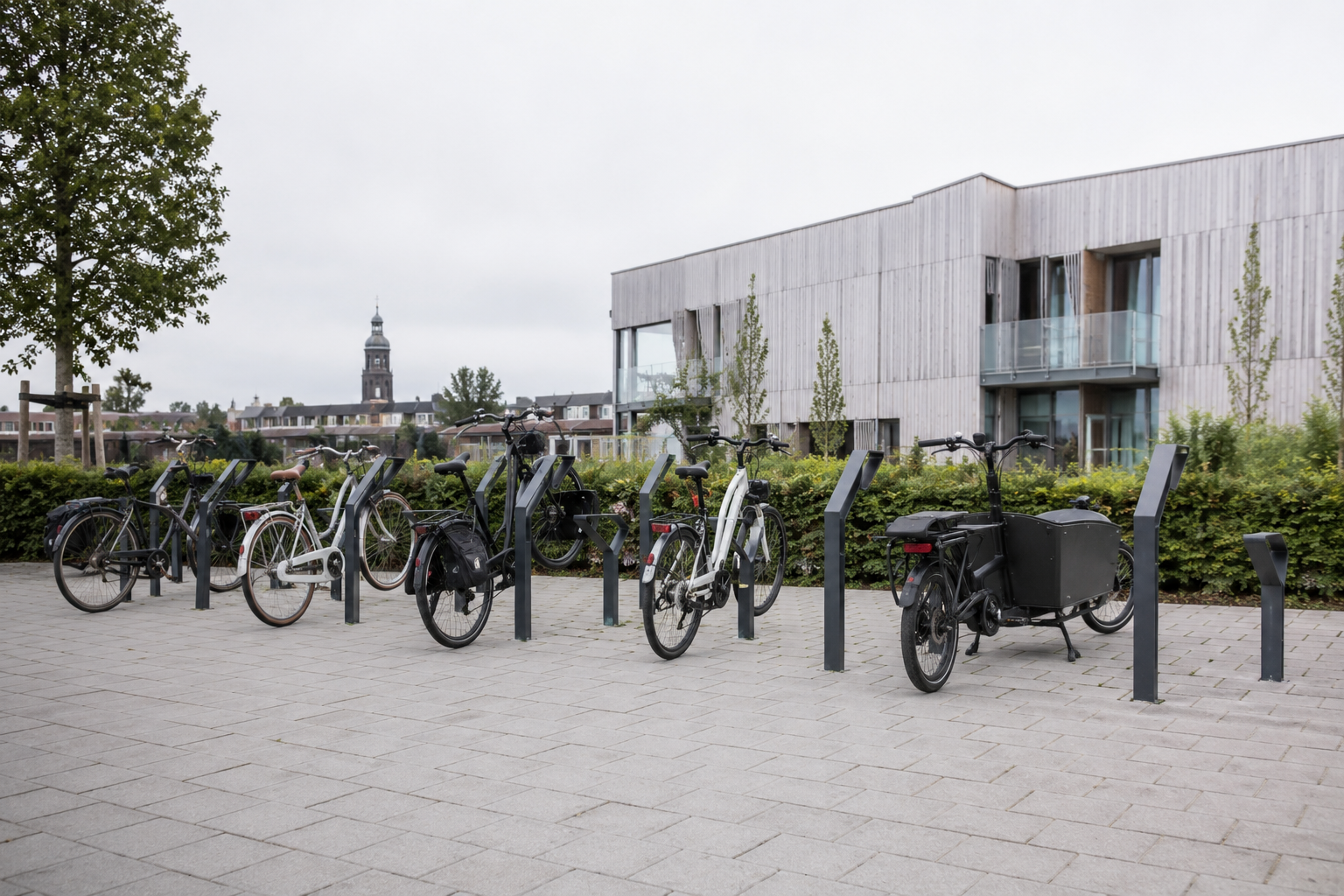
In a bicycle parking project, attention usually goes to the big choices: will there be a roof, how many spaces will there be, where do we put it. The rack itself is often treated as a detail — a commodity you order alongside.
That is precisely where it goes wrong. The rack determines whether people actually put their bike in it, how many bikes fit in practice, and whether your shelter will still give the impression you paid for three years from now. A shelter that counts fifty spaces on paper but is full with thirty bikes and ten bikes standing beside it does not have a capacity problem. It has a dimensioning problem.
This article is about the mechanics: which systems exist, how to calculate capacity correctly, which dimensions matter, and why the price per space differs so much. It is about collective installations for municipalities, schools, companies and property developers — not about a small rack for the garage.
The types at a glance
Sheffield-style stands. The most recognisable form: a sturdy hoop the bike leans against and to which you can lock both the frame and a wheel. For most public applications this is the workhorse, and for good reasons. They are low-maintenance, accept every type of bicycle — including cargo bikes, children's bikes and bikes with panniers — and they offer the best protection against theft because you can secure the frame. That last point is not a detail: a lock that only goes through the front wheel protects against nothing. The drawback is the space they take up. Each bike needs more linear metres than in systems that place bikes closer together.
High-low racks. Racks where bikes stand alternately in a higher and a lower position. The reason is purely practical: otherwise handlebars and pedals interlock, which prevents you from placing bikes close together. The height difference allows a smaller spacing without the bikes touching. This yields noticeably more spaces per linear metre than a single-level layout. Point of attention: the high position takes slightly more effort to use. With heavier electric bikes that weighs more heavily than it used to.
Two-tier systems. Two levels above one another, where the upper tier slides out and rises on a spring. In locations with high parking pressure and limited ground area — stations, large schools, dense city centres — this is the only way to genuinely double capacity. Two conditions. You need sufficient clear height, and the operation must be light enough that people actually use the upper tier. A two-tier system whose upper level stays structurally empty because it is too heavy to operate is an expensive single-tier shelter. With the weight of modern e-bikes, the quality of the spring mechanism is decisive here.
Wheel-clamp racks. Systems in which the front wheel sits in a clamp or slot. They are compact and cheap, and therefore popular when price per space is being compared. We advise against them for most public applications, for two reasons. The frame usually cannot be locked to them, which severely limits protection against theft. And a bike held only by the front wheel stands unsteadily — in wind or when knocked, the wheel bends. In places where bikes stand for long periods or where theft is an issue, those drawbacks outweigh the gain in space.
Bike lockers, drums and lockable units. For long-stay parking and maximum protection: individual lockers or collective drums that fully enclose the bike. Suitable for neighbourhoods without private storage, at stations and at mobility hubs. The investment per space is higher and a management or reservation component comes with it.
Capacity: calculating with the right figures
This is where the difference lies between a shelter that works and one that frustrates.
Collective racks are usually supplied in modules — often in steps of five or six bikes, sometimes ten. That is convenient for planning, because you can match your needs fairly precisely and extend later with the same module. Do pay attention to what a manufacturer means by capacity. A module sold as six spaces assumes a certain spacing and a certain type of bicycle. If either changes, the usable capacity changes — not the figure on the data sheet.
Centre-to-centre spacing is the figure that determines whether your shelter actually fills up: the distance between two parking positions, measured from centre to centre. In practice you see values between roughly 375 and 500 millimetres. At the tight end of that range it only works with a high-low layout, where the height difference lets handlebars avoid each other. In a single-level layout a more generous spacing is needed, otherwise the handlebars get in the way.
The temptation is to go tight: smaller spacing means more spaces in the same metres, and therefore a better price per space on paper. But a shelter that is too tight never fills up completely. People skip the awkward positions, put their bike beside it, and you end up with an installation that costs more per space actually used than a more generous layout.
Do not plan for current use. Cycling in Flanders has been growing for years, and a shelter lasts fifteen years. Anyone who provides exactly enough spaces for today's situation will be short within a few years — and extending is always more expensive than building generously from the start. If you work with modular systems you can spread that risk: start with what is needed, but physically reserve the space to slide in the same module later.
The dimensions nobody checks
The classic bicycle is no longer the standard, and that is where most capacity calculations come unstuck.
Electric bikes are wider, longer and considerably heavier. That weight matters most in systems where you have to lift or push the bike upwards. Where a shelter worked for everyone twenty years ago, it is now too heavy for part of its users.
Cargo bikes need considerably more room in both width and length and simply do not fit in a standard position. In locations where cargo bikes occur — schools, residential neighbourhoods, mobility hubs — it pays to provide a few wider spaces rather than hoping it will work out. Without those spaces they end up blocking the rest.
Panniers and child seats make a bike considerably wider. A shelter dimensioned exactly for a bare bicycle does not work for the bicycle as people actually use it.
Manoeuvring space between the rows is what is forgotten most often. You need an aisle where someone can turn with a bike in hand and where two people can pass each other. If that aisle is too narrow, the rear spaces stay structurally empty, however good the rack itself may be.
Anchoring and installation
A bicycle rack that stands loose is not a rack but an obstacle. The method of installation depends on the surface and determines how stable the whole thing remains.
On concrete you can usually fix directly, which is the fastest and most stable solution. With block paving or slabs, the fixing has to pass through the surfacing into a load-bearing layer, otherwise movement develops. On loose ground a foundation is needed, which affects the groundwork and therefore the cost.
Two practical points. A properly anchored rack prevents subsidence and makes it considerably harder to move or steal the rack itself. And when anchoring in public space, checking underground services in advance is not an unnecessary luxury.
Material and finish
A bicycle rack stands outdoors permanently and has to cope with rain, frost, UV and road salt in winter. On top of that comes intensive mechanical use: locks scraping along it, pedals grazing it, bikes falling against it.
The surface treatment determines how that plays out. A properly treated rack keeps its appearance for years with minimal maintenance; a rack built too lightly shows rust spots within a few winters at exactly the places with the most contact. Because a bicycle shelter usually stands in a visible spot, that is immediately noticeable.
Maintenance is limited to periodic cleaning and checking the fixings. Most of the problems we see in the field are not caused by wear but by too light a design at the outset.
Why the price per space differs so much
Anyone comparing quotations on price per bicycle space is rarely comparing like with like. These factors explain the difference.
The system type. Sheffield-style stands, high-low racks, two-tier systems and lockable units each sit in a different order of magnitude. That is the single biggest factor.
The spacing used. A supplier who calculates more tightly arrives at more spaces for the same installation, and therefore a lower price per space. On paper. So always ask for the centre-to-centre spacing, not just the number.
Material and surface treatment. This is where service life is decided, and where cheap quotations have most often been trimmed.
The subsurface and the installation method. Fixing directly onto existing concrete is something quite different from a full foundation in a green area.
Roofing. With or without a roof changes the order of magnitude entirely. When that pays off we cover in a separate article.
Installation, transport and tender requirements. Accessibility of the site, planning and specific requirements from a tender specification all play a part.
That is why we work with a tailored proposal instead of a rate from a catalogue. That way you pay for what your location genuinely requires — and not for a capacity figure that is never achieved in practice. You will find the actual figures in the Herva-Doublet Platform.
From choice to proposal
Do you know roughly how many spaces you need and where they should go? Then the step to a concrete proposal is a short one. Send us the location, the desired number of spaces, the surface and any requirements from a tender specification, and we will work out a proposal — including a realistic capacity calculation rather than an optimistic one.
As a partner in visual communication for the public domain we look further than the rack. Bicycle parking, wayfinding, street furniture and branding all come from one hand with us, so that the whole hangs together. We make you stand out — including with a bicycle rack that adds up.
Frequently asked questions
Ready to take the next step?
Request a 3D design or an advisory meeting, or request access to prices in the Herva-Doublet Platform.