Vinyl graphics: vehicles, windows and floors that work for you
Vehicle lettering, window film and floor graphics: which film where, how long does it last and why does the price differ so much?
Of all forms of visual communication, vinyl graphics are the most underestimated. They cost a fraction of a facade sign, they are quickly fitted, and they work in places where nothing else can: on a moving van, on a shop window, on a warehouse floor.
And precisely because it is so accessible, it is often approached too lightly. A film intended for indoor use ends up on a van, a window film fades after a single summer, a floor graphic curls at the edges after three weeks. The material was cheap; doing it again was not.
This article covers which film belongs where, how long it lasts, what you should know in advance about substrates and removability, and why the price differs so much.
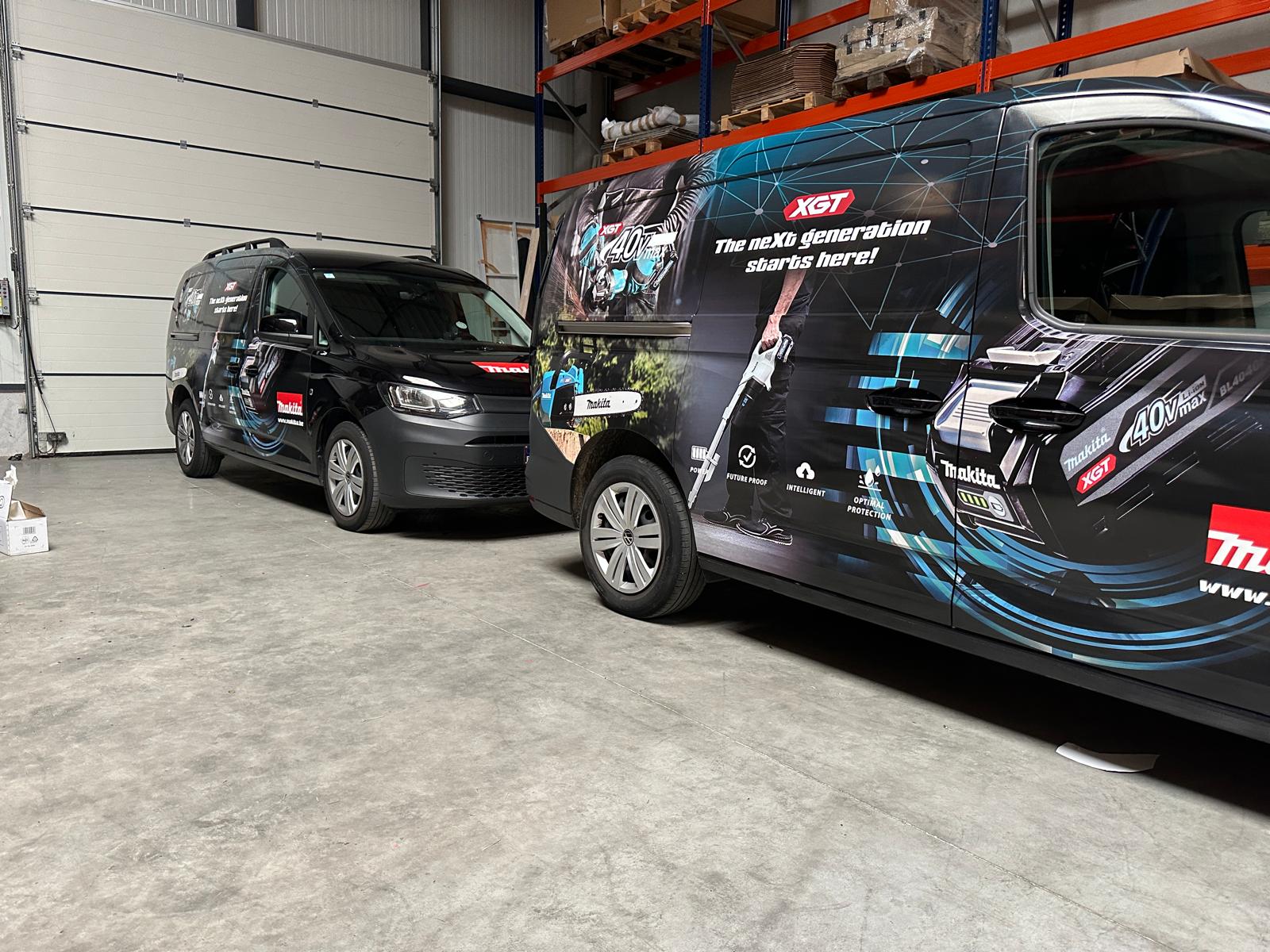
Vehicle lettering: your cheapest advertising medium
A van that drives around every day passes hundreds of people. No other form of advertising has such a low cost per contact — provided the lettering is actually read, and that is usually where it goes wrong.
Three levels, and the difference is considerable.
Simple lettering. Individual letters and a logo on the existing paintwork. Quick, affordable, and enough for many companies. It works best on a light-coloured vehicle, where dark lettering contrasts.
Partial lettering. A larger area or a graphic element across part of the vehicle, which strengthens the image without having to wrap the entire vehicle. For most companies this is the best balance between impact and cost.
Full wrapping. The vehicle is completely covered in printed film. Maximum impact, and it makes the vehicle's own colour irrelevant — useful when you want to give a fleet of differently coloured vehicles one single look. More expensive and more labour-intensive, and it requires a vehicle in good condition.
What determines legibility. A vehicle is read in motion, often from the side and usually within a few seconds. That means: limit it to the name, what you do and one contact detail. Anyone who puts the entire service offering, the address, the VAT number and three social media handles on the side ensures that nothing sticks. Choose one contact route — usually the website or the phone number, not both.
And look at what happens behind the lettering: sliding doors, ribs, recesses and handles break up a graphic element. A design that works on a flat drawing can cut a logo in half on the actual vehicle.
Window graphics: from shopfront to privacy
On glazing, film does three things at once, and it pays to know in advance which one you want.
Communicating. Opening hours, promotions, the name on the door, a message in the shop window. For temporary campaigns there is film that is easy to remove; for permanent information you choose a specification that stays put for years.
Screening. An etched-glass look or a matt film provides privacy without taking away light. Classic for meeting rooms, consulting rooms and ground-floor offices. It is also the simplest way to make a glass wall safer, because a fully transparent glass wall is not always noticed — a marking at eye level stops someone walking into it.
Solar or insulating. Film that keeps out heat in an office with a lot of south-facing glass. This is a technical application with its own specifications, where the choice is determined by the glass type and the orientation.
With glazing, watch one thing: double glazing and laminated glass do not tolerate every film. A dark, strongly heat-absorbing film on the wrong glazing can cause stress in the glass. So always ask which film is suitable for your glass type — that is not a detail but a warranty issue.
Floor graphics and floor marking
People look at the floor anyway. That makes floor graphics more effective than most people think, and it is why they often work better in a warehouse than a sign on the wall.
Two very different applications. In a shop or reception area it is about communication: an arrow, a message, a pointer to a department. In a warehouse or production environment it is about safety and organisation: walkways, forklift zones, storage bays, safety distances.
In both cases the film must withstand whatever drives or walks over it, and it must be anti-slip when it lies on a walking route. A smooth film in an entrance area that gets wet in the rain is a risk you do not want.
The substrate determines whether it works. A smooth, closed floor is ideal. Rough concrete, old tiles with wide joints or a floor with a silicone-like coating hold film poorly. In those cases a milled or painted marking is often the better solution than film that comes loose after three weeks.
Film, lifespan and what shortens it
The differences between films are technical, but one distinction explains most of it.
Cast film is thin, flexible and dimensionally stable. It follows curves and ribs without wanting to shrink back, and it holds its colour for years. This is what you need on vehicles and on anything curved.
Calendered film is thicker, stiffer and cheaper. Fine on flat surfaces and for shorter-term applications, but on a curved substrate it pulls back over time — hence the curling corners you sometimes see on older vans.
In addition, the protective layer determines how the colour holds. A laminate protects against UV, scratches and cleaning, and it is exactly the item that is missing from a sharply priced quote without anyone noticing. Especially for vehicles that go through a car wash, it is the difference between looking good for four years and looking good for one.
And orientation counts. The south side of a vehicle or a building receives a multiple of the UV load of the north side. Two identical graphics therefore age noticeably differently.
Removal: think about it in advance
This is the question that only gets asked when it is too late. Film that has been on a substrate for years cannot always be removed without problems.
On vehicles the paintwork matters: film on a repaired or resprayed panel can take the paint with it on removal. With leased vehicles it is also a contractual matter — agree in advance who pays for removal and in what condition the vehicle must be returned.
The same principle applies to windows and walls: there is film designed to stay for a long time and film designed to come off easily, and that is a choice made at the time of ordering, not afterwards. In rented premises that is a reason to ask the question explicitly.
What determines the price
Two quotes for "lettering our van" can be far apart, and not without reason.
The extent of the print. Individual letters, partial lettering and a full wrap are in different orders of magnitude.
The film and the laminate. Cast or calendered, with or without a protective layer: this is where lifespan is decided.
The complexity of the vehicle or surface. Ribs, sliding doors, recesses and deep curves cost fitting time. A flat van side is something else than a van with a lot of profiling.
The preparation. A vehicle or window has to be thoroughly cleaned and degreased. On an older vehicle or a dirty substrate that takes more time.
The design. Do you supply a print-ready file or do we work out the design to the actual vehicle dimensions? The latter is usually the difference between lettering that is right and lettering that turns out differently on the vehicle than on screen.
The quantity. A fleet of twelve vehicles works out cheaper per unit than a single one, especially when the design is developed only once.
That is why we work with a tailored proposal rather than a rate per square metre. You will find the actual figures in the Herva-Doublet Platform.
One image across vehicle, facade and interior
Vinyl graphics rarely stand alone. The vehicle drives to a building with facade signage, past a totem, to a reception with wayfinding. Anyone who orders these elements separately ends up with a brand that looks slightly different on every carrier: a different blue on the van than on the facade, a different typeface on the window.
That is exactly where we make the difference. Vinyl graphics, facade signage, illuminated signage, wayfinding and interiors all come from one source, from design through production to installation. One point of contact, one brand identity — and a fleet and a building that look like the same company.
Frequently asked questions
Further reading
Related articles
Ready to take the next step?
Request a 3D design or an advisory meeting, or request access to prices in the Herva-Doublet Platform.