
Outdoor advertising panels: which material lasts how long?
Which material suits your outdoor sign? Lifespan, UV-resistant printing, mounting, permits and why the price differs.
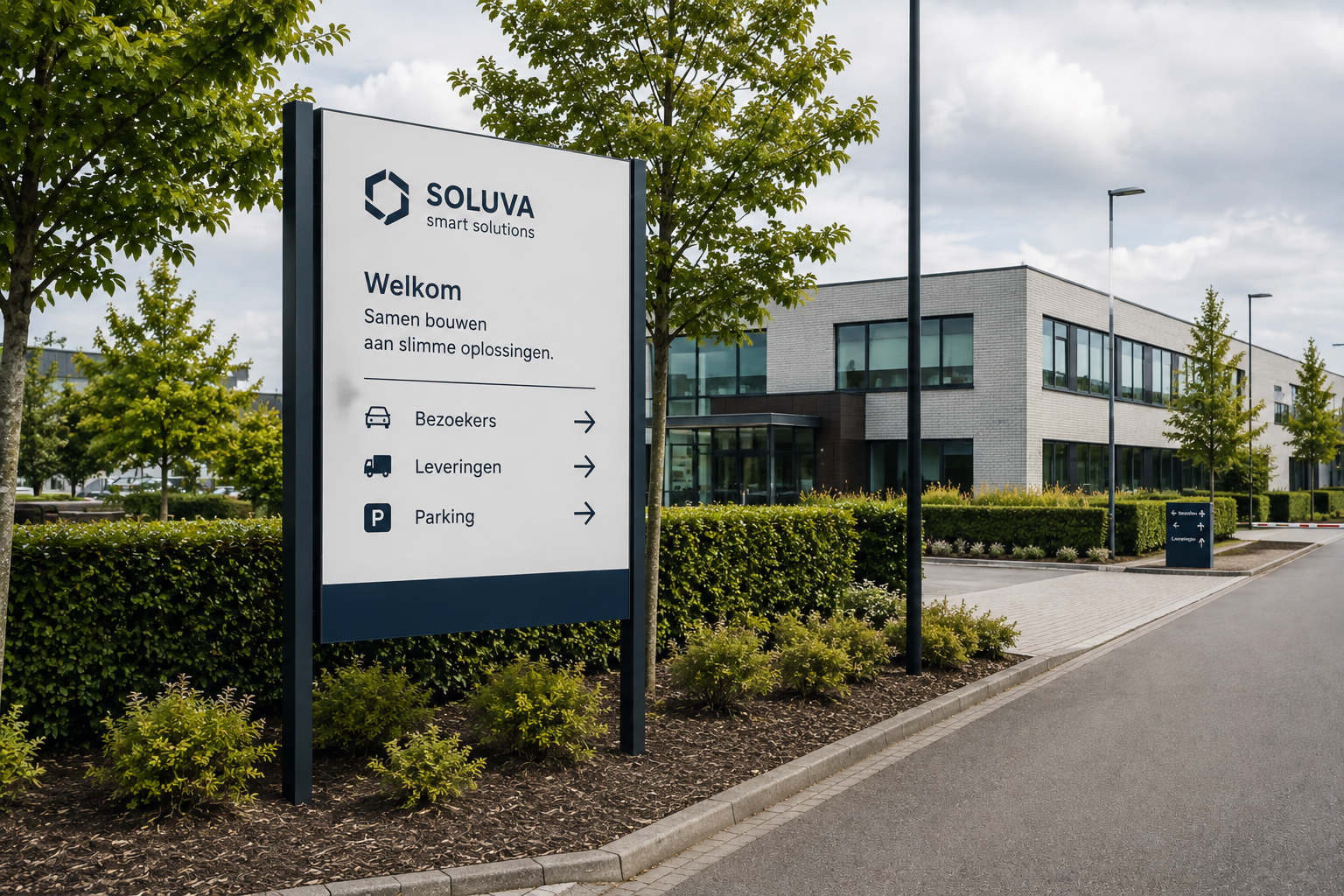
Ordering an advertising panel seems like the simplest purchase in visual communication. You supply a design, you choose a format, and a few days later something is up. That is exactly why it is also the purchase that most often goes wrong — not on delivery, but eighteen months later.
The panel has warped, or the red has faded to orange, or a corner came loose in the first autumn storm. The panel itself was not expensive. Remaking it, reinstalling it and the period in between, during which something scruffy hung on your facade or site, certainly were.
This article is about the choice that makes that difference: which material suits which application and which lifespan, how the printing holds up, how you mount it, and why the price differs so much.
First: how long does it have to last
This is the question that determines every other choice, and it is rarely asked explicitly. Yet almost every outdoor application falls into one of three categories.
Temporary, weeks to a few months. A promotion, an event, an election, a building site finished within the season. Here a lightweight, affordable version is defensible: the panel does not need to last five years and will not be given that time anyway.
Medium term, one to three years. A sales board on a project, a site board on a longer build, temporary wayfinding during a refurbishment. Here a choice that is too lightweight starts to hurt, because you have to replace the panel within the period in which it was still doing its job.
Permanent, five years and more. A name board at the entrance, an information board in a park, wayfinding on a business park, a regulations board at a sports ground. Here, saving on material and finish is always more expensive than it looks.
The classic mistake is ordering a permanent panel to the specification of a temporary one — usually because the comparison was made on price without lifespan being part of it.
The materials in a row
Aluminium composite panel. Two thin outer aluminium layers with a plastic core in between. This is the workhorse for permanent outdoor applications, and rightly so: it is flat, rigid, light in relation to its strength, and it does not warp. It keeps its shape for years and, with the right printing and protection, its colour too. Suitable for name boards, information boards, wayfinding and anything that has to stay up longer than a season. Point of attention: thickness matters. For small panels a light version is enough; as the format grows you need more thickness or a supporting frame, otherwise the surface starts to flex in the wind.
Solid PVC sheet. A closed plastic sheet, generally light and easy to work. Affordable and perfectly fine indoors and for shorter outdoor applications. Outdoors it is sensitive to two things: UV radiation, which discolours it and makes it more brittle over time, and temperature swings, which can make larger sheets sag or deform. For a promotional board that hangs for three months that is no objection. For a board that has to stay on a facade for five years, it is.
Fluted plastic board. The light, hollow plastic sheet with vertical flutes. Extremely affordable and light, and therefore the standard for short-lived applications: election boards, event boards, temporary indications, promotional boards on a fence. The downside: limited rigidity, and the fluted structure shows through the print in raking light. It is deliberately a temporary material — that is not a shortcoming but the intention.
Wood and wood composite. Warm and fitting in a natural setting: parks, walking routes, nature reserves, playgrounds, historic centres. Where a plastic sign looks out of place, wood fits naturally. It does require maintenance — a treatment rhythm you have to keep to — and the joints and the underside are where it always starts. Wood composite largely avoids that at the cost of some of the natural look.
Textile and banners. For large surfaces that are temporary or that go on a fence or scaffold: site banners, facade banners, sponsor panels along a pitch. Fabric is light, can be made large without the weight running away, and in a perforated version it lets wind through — which on a fence or scaffold is the difference between a banner that stays up and one that goes with the first storm. The tension of the fabric determines how it looks: a slack banner looks cheap, however good the print is.
Enamelled and special versions. For applications where decades are expected and where vandalism, heat or chemical loads come into play. More expensive to buy, but in that context the only version that reaches the required lifespan.
The printing determines whether it keeps its colour
The material determines whether the panel keeps its shape. The printing determines whether it keeps its colour — and that is what people notice first when a panel ages.
The ink and the printing process. Outdoors you need a UV-resistant version. A print intended for indoor use fades visibly outside within a year, and not evenly: red and orange go first, so a logo skews in colour before it goes pale.
The protective layer. A laminate or varnish protects against UV, scratches and cleaning. It is a small extra cost at purchase and it is exactly the item that is missing from a keenly priced quotation without anyone noticing. So ask about it explicitly when comparing.
The orientation. A panel facing south receives a multiple of the annual UV load of the same panel facing north. Two identical panels on the same site can therefore age very differently — that is not a product fault but physics, and it is a reason to deliberately specify heavier for a south-facing position.
If you want an objective comparison between quotations, do not ask which material but which printing technique, which protective layer and which expected colour fastness outdoors. That tells suppliers apart faster than a price per square metre.
Mounting and wind
A panel is a surface that catches the wind. The larger the surface, the greater the force on the fixings — and that relationship is not linear: a panel twice as large catches more than twice as much.
For facade mounting the approach depends on the substrate: masonry, concrete, sandwich panel, glass or an insulated facade each require something different. For insulated and ventilated facades the same warning applies as for facade signage: drilling through without allowing for watertightness and thermal bridges causes a moisture problem years later.
For free-standing panels on posts the foundation is decisive, and it follows from the soil conditions on site. Sandy ground behaves differently from clay; existing paving requires a different approach from a green area. This is the item most often underestimated in a first estimate, and the reason why a panel can end up leaning after two winters.
For fencing and scaffolding, permeability is the theme. A closed banner on a site fence acts like a sail. A perforated version, or a banner with enough fixing points and correct tension, does hold.
And when digging in public space: check in advance what is in the ground. A foundation pit on a business park or alongside a road is no place for surprises.
Permits
Fixed advertising panels are subject to municipal planning rules on dimensions, placement, height and lighting. For temporary panels there are often separate rules: how many may be placed, for how long, and at what distance from the road.
Along regional roads and on public land, conditions set by the road authority are added, and these are stricter than what applies on private ground — logically so, because road safety comes into play. A panel that restricts visibility at a junction or that resembles traffic signage is not permitted and can be removed.
For site and sales boards many municipalities apply specific, more flexible rules, but with a maximum duration. Assume this has to be checked before you produce; we include that question in the file as standard.
Maintenance and when to replace
Outdoor panels ask little: periodic cleaning with a non-abrasive product and a check of the fixings, certainly after a stormy spell. What ends the lifespan in practice is almost never the construction but the appearance — a faded print or a weathered edge.
Two practical tips. Do not clean a laminated panel with aggressive products or a pressure washer held close: you damage exactly the layer that protects the panel. And keep the print file with the correct specifications. When replacing or extending, that saves time and ensures the new panel is identical to the existing one, rather than just slightly different in colour.
That last point is an underestimated problem on larger sites: order panels in three rounds without recording the specifications and you end up with three generations of panels that visibly differ from one another.
Why the price differs so much
Two suppliers both quoting a two-metre advertising panel can be far apart. The differences lie here.
The material and the thickness. This is the biggest factor, and it is also what determines the lifespan.
The printing technique and the protective layer. UV-resistant ink and a laminate cost a little more and are exactly what stops your logo fading within the year.
The format and the quantity. Larger runs become more favourable per unit; larger formats require more rigidity or a supporting frame.
The finishing. Rounded corners, reinforced edges, drilled holes, cutting or milling to shape: each adds something.
The mounting method and the substrate. Directly onto a flat facade is something other than posts with a foundation or a mounting at height.
The installation. Accessibility, working at height, working outside opening hours or on a site in use.
The permit. The procedure itself, and sometimes the adjustments that follow from it.
That is why we work with a proposal tailored to your application rather than a rate per square metre. That way you pay for the lifespan you need — not too much for a permanent version where a seasonal board would have done, and not too little for a panel that has to stand for five years. You will find the actual figures in the Herva-Doublet Platform.
One image across your entire site
Advertising panels rarely stand alone. On most sites there is also facade signage, wayfinding, parking indications and sometimes a totem at the entrance. Order those elements separately and you get a site where every component looks slightly different: another shade of blue, another typeface, another finish.
That is precisely where we make the difference. Panels, facade signage, totems, wayfinding and branding all come from one hand, from design through production to installation. One point of contact, one brand identity, one file — and a site that feels as though it was meant that way. We make you stand out. Not sure yet which version you need? Tell us where the panel will go and how long it has to stay, and the rest follows from that.
Frequently asked questions
Further reading
Related articles
Ready to take the next step?
Request a 3D design or an advisory meeting, or request access to prices in the Herva-Doublet Platform.