
Bicycle lockers and enclosed shelters: when secure parking pays off
Enclosed shelter, locker or secure room? When secure bicycle parking pays off, how to manage access and why the price differs.
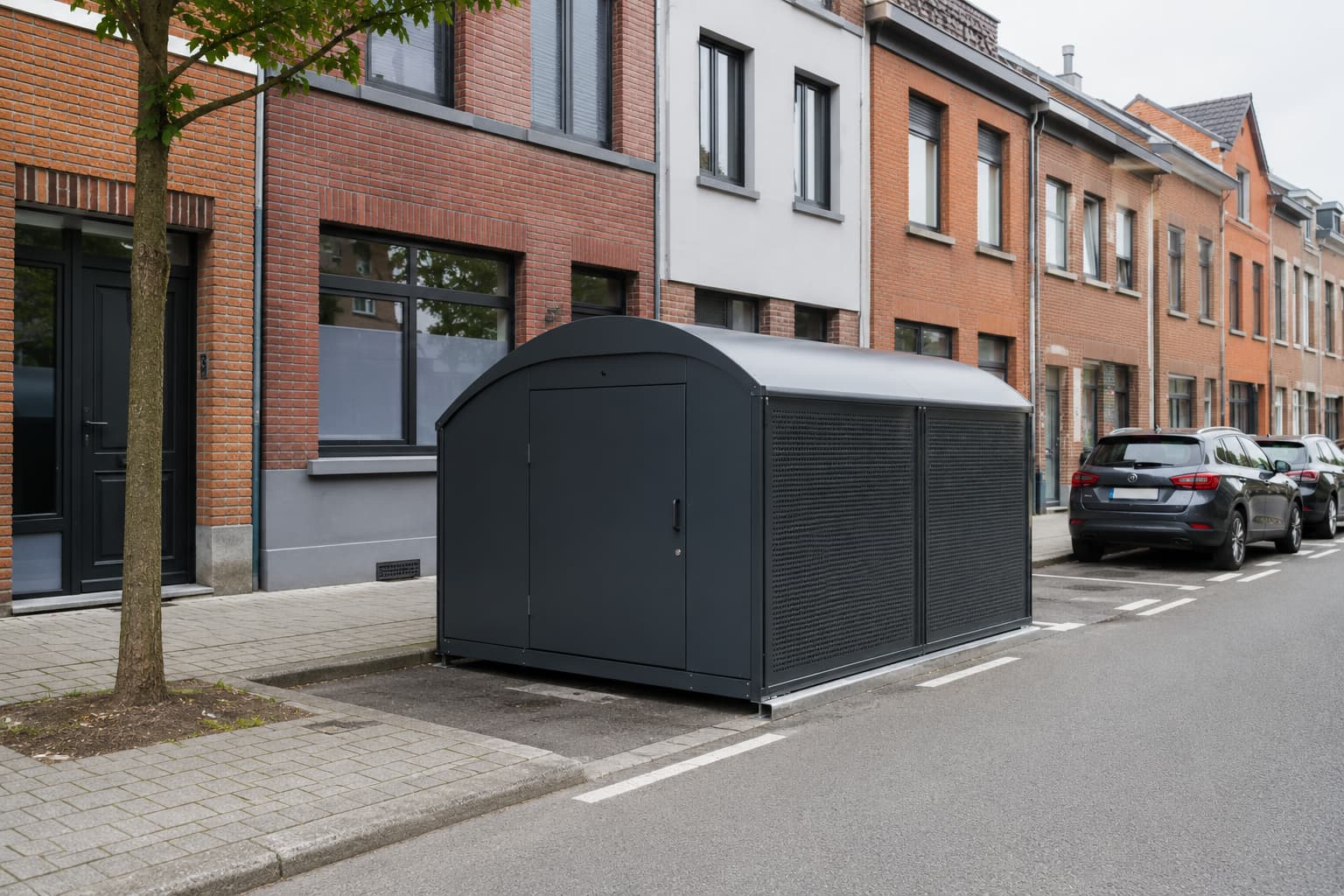
Most bicycle parking questions are about numbers. How many spaces fit, what does a space cost, how do we fit more on the same metres.
For enclosed parking it is different. There the question is not how many but for whom — and the answer to that question determines the entire project. A bicycle locker or a cabinet is not simply a more expensive parking space. It is a space with a user, an allocation, a key or code, and someone who manages it. Anyone who skips that last part installs an expensive structure that after two years is half empty or where no one knows any longer who holds a key.
This article is about when enclosed parking pays off, what forms exist, how you organise access, where to place them, and why the price varies so much.
When enclosed parking pays off
There is one question that carries most of the decision: how long does the bike stand there, and how much is it worth?
Neighbourhoods without their own bicycle storage. This is the classic application. In densely built streets with terraced houses without a garage or yard, the bike stands permanently outside, or it is carried through the hall every day. A locker on the street solves both — and it immediately solves a problem the municipality also has: bikes permanently chained to railings and posts.
Stations and mobility hubs, for the regular commuter. Someone who leaves their bike for ten hours five days a week wants security. A limited number of enclosed spaces alongside the open capacity is often the most sensible set-up: the mass in the open shelter, the expensive bikes and the daily users behind a lock.
Business sites and campuses. For staff who arrive on an expensive e-bike or speed pedelec, an enclosed space is a concrete argument to keep cycling. It is also one of the few mobility measures whose effect is immediately visible.
Residential projects and apartment buildings. In new build or renovation, a collective enclosed bicycle storage is often required or strongly recommended, and it partly determines how residents use their bikes. A storage that is hard to reach is not used — however safe it may be.
Where it does not pay off: short-stay parking. On a shopping street, a square or the entrance of a public building, an enclosed solution is overkill. Someone who stays ten minutes will not open a locker. There, a good Sheffield stand on every axis wins.
The forms, one by one
Collective bicycle lockers. An enclosed structure that typically holds five or six bikes, with one shared access for the users who have a space in it. Compact enough to fit in a parking bay on the street, which makes them suited to residential neighbourhoods: you trade one car parking space for five or six protected bicycle spaces. Advantage: many spaces per square metre and a relatively low cost per space. Point of attention: all users share the space, so there must be clarity about who uses which spot, and there is a degree of mutual dependence.
Individual bicycle lockers. One enclosed cabinet per bike. Maximum protection and privacy, and no discussion about who has which space. Often used at stations, business sites and places where renting per user is the aim. Drawback: more space and a higher cost per space. A practical point also arises: a locker sized for an ordinary bike will not fit a cargo bike, sometimes not even an e-bike with a wide handlebar. So always ask for the usable internal dimensions and not only the external dimensions.
Enclosed collective spaces. A fenced or walled zone with access control, in which a standard rack system stands. This is the scalable solution: one access, many spaces, and the racks inside can be two-tier or high-low. Suited to business sites, campuses, larger stations and residential projects. It is usually the cheapest solution per protected space once you go above fifteen to twenty spaces.
Storage rooms in buildings. In new build or renovation the most integrated solution. Here accessibility counts above all: a storage room at the back of a basement with a staircase and a heavy door will be structurally avoided, however well secured it is. Level access, sufficiently wide doors and a short route outside determine whether it is used.
Access: the part that goes wrong most often
For open parking this issue does not exist. For enclosed parking it is half the project, and it is rarely budgeted.
Keys are simple and cheap. They are also the reason lockers become unmanageable after three years: keys get lost, are passed on, move away with a user who leaves. Each lost key in principle means a cylinder change.
Codes are more flexible, but a code everyone knows is no longer security. They work when you change the code periodically, and that again requires someone who does it and communicates it.
Badges or digital access are more expensive to purchase and by far the easiest to manage: a user who leaves is deactivated, and you can see who has access. For business sites that already work with badges, this is usually a small step. For municipalities with dozens of lockers spread across the city, it is the difference between manageable and unmanageable.
Apart from that, there should be an allocation policy, and that is a policy choice, not a product choice. Who gets a space, for how long, under what condition, how does someone get on a waiting list, and what happens when a space goes unused for months? Municipalities that lay this down in advance have lockers full of active users. Municipalities that sort it out afterwards have lockers partly occupied by people who no longer live there.
Placement and practical details
On the street. A locker in a parking bay is the standard solution in residential neighbourhoods. Mind the manoeuvring space: someone must be able to open the door with the bike in hand and get in without standing on the carriageway. Also mind which way the door swings open relative to traffic.
Visibility and social safety. An enclosed structure in a deserted spot is an attractive target, precisely because breaking in can happen undisturbed. A spot in view, with lighting nearby, is safer than a hidden corner — even if that feels counter-intuitive.
Accessibility. Step-free access and sufficient door width. With the weight of modern e-bikes, a step or a narrow passage is reason enough not to use the solution.
Cargo bikes. Provide space for them explicitly, or state clearly that it is not possible. A cargo bike user who is allocated a space where their bike does not fit is a complaint you could have avoided.
Charging points. Increasingly requested, and an enclosed space is the logical place for them: the bike stands there long enough to charge, and the equipment is protected. It does require a power supply and attention to safety.
Material, maintenance and lifespan
An enclosed shelter stands permanently outside and is by definition a structure that people open and close daily. Two kinds of wear therefore: the weather, and use.
For the structure the same rule holds as for all street furniture: a weather-resistant finish with a solid surface treatment keeps its appearance for years, while too light a finish shows rust spots after a few winters precisely where most contact occurs.
What counts extra for enclosed shelters is the locking hardware. That is the part most stressed and the first to fail. Ask how it is executed, whether it can be replaced without tackling the whole structure, and whether parts remain available in the long run.
Maintenance otherwise remains limited: periodic cleaning, checking the hinges and locking hardware, and for collective lockers a periodic check of whether the spaces are still actually used.
Why the price varies so much
The type of solution. An individual locker, a collective locker and an enclosed space with racks each sit in a different order of magnitude per space. Above a certain number of spaces, an enclosed space is usually the most advantageous per protected bike.
The number of spaces. Both per unit and in total: more units gives a more favourable price per piece.
The access system. Key, code or digital access makes a real difference, both in purchase and in what it costs you annually in management.
Material and finish. Determines the lifespan, and is the first thing cut in tight quotes.
The ground and the anchoring. On existing concrete or in a parking bay is different from a foundation in a green zone.
Power supply. For internal lighting or charging points.
Placement and accessibility. Working in a residential street with limited space, or phased across several sites in the municipality.
That is why we work with a bespoke proposal rather than a rate per space. This way you pay for the solution that suits your users — and not for security no one needed, or conversely, for a solution that becomes unmanageable after a year. The concrete figures are in the Herva-Doublet Platform.
From question to proposal
The most useful first step is not a number but a profile: who will use these spaces, how long does the bike stay there, and who will manage the allocation. With those three answers, the choice between locker, cabinet and enclosed space is usually made quickly.
Send us also the location, the available space and any requirements from a specification, and we will work out a proposal — including the signage and information carriers that explain how to obtain a space, because without that last part even a good solution remains underused.
Frequently asked questions
Further reading
Related articles
Ready to take the next step?
Request a 3D design or an advisory meeting, or request access to prices in the Herva-Doublet Platform.