
POS and displays: why most fail and which ones work
Where do you place a display, how long should it last and how do you roll it out across stores? Types, materials and why the price differs.
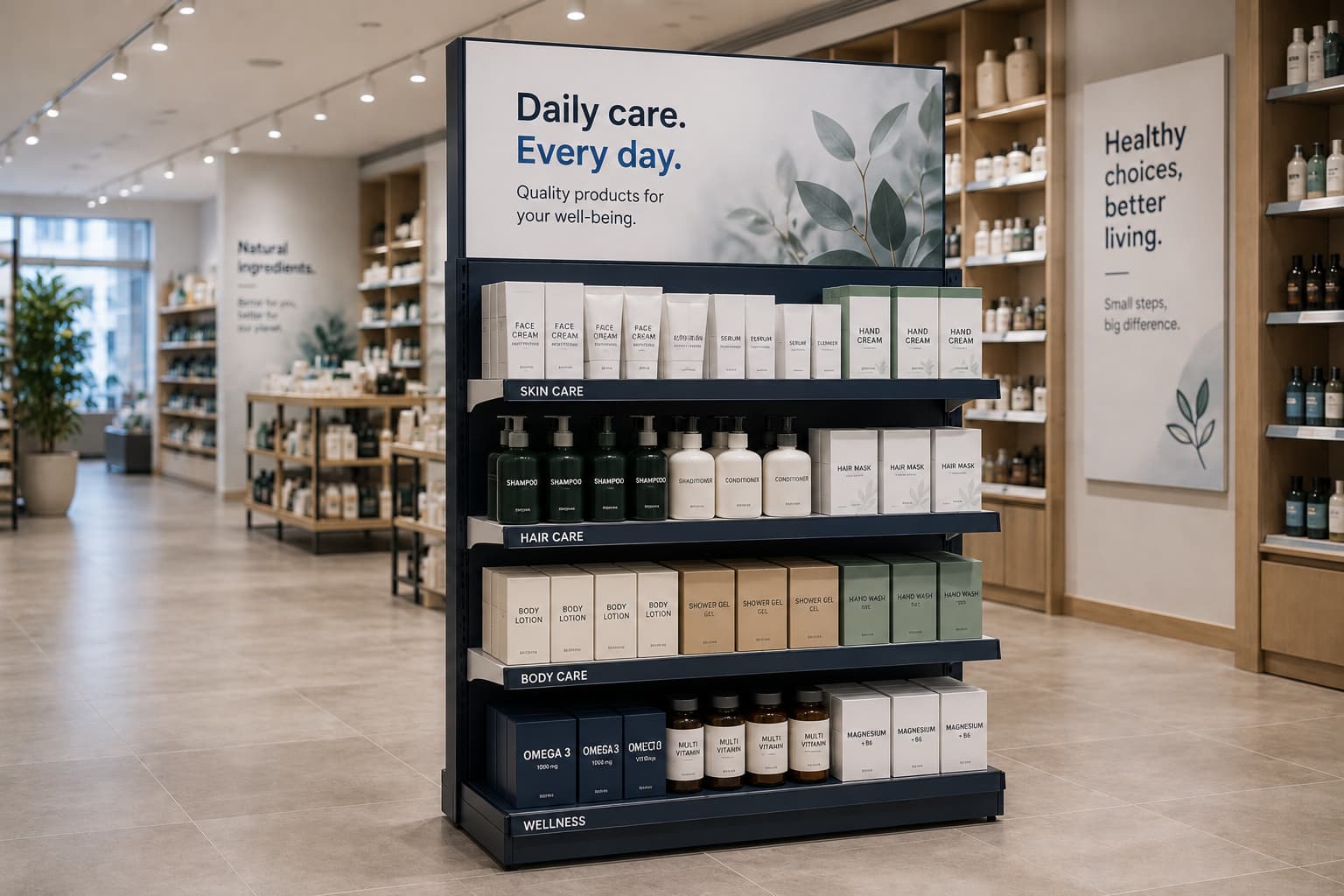
There is a reason why retailers' warehouses are full of displays that never made it to the shop floor. They were too large for the available spot, they did not fit through the branch door, or they stood there for two weeks and were put away because they were in the way.
A display is in fact the only communication tool that has to physically compete with the space it stands in. An advertisement takes up no space. A display does — and in a shop, floor space is the scarcest commodity there is.
This article covers what makes a display actually work: where it stands, how long it needs to last, how you roll it out across multiple branches, and why the price differs so much.
Start with the spot, not the product
The order in which most displays come about is: there is a campaign, a display is designed, and then a place is sought where it fits. That is the reverse order.
What the spot determines.
The customer route. People move through shops in predictable patterns: to the right of the entrance, along the edge, towards the till. A display in that flow works; a display in a dead-end corner does not, however attractive it is.
The decision-moment zone. Near the shelf where the product sits, or just before the till where impulse purchases happen. A display three aisles away from the product creates interest without being able to capitalise on it.
The available square metre. This is the conversation that must be held beforehand with whoever manages the shop. A branch manager who was not involved will put your display away — and is usually right to do so.
The passage. A display that narrows the walking route to below a comfortable passage width is moved or removed. In shops where wheelchairs, pushchairs and trolleys pass through, that is no detail.
Practical advice that pays off: measure one branch before you design anything, and take the narrowest doorway in your branch portfolio as your dimension. A display that has to be split in two to get inside is a display that stays in the warehouse.
The types in a row
Cardboard displays. Light, affordable and fully printable in any shape. For a promotion of a few weeks to a few months this is the logical choice, and they are recyclable.
Limitation: they tolerate no moisture, no heavy products and no rough handling. In a supermarket aisle where trolleys scrape past, a cardboard display is damaged after two weeks — which looks worse than no display.
Plastic or panel-material displays. Sturdier, reusable and suited to longer periods. The printed part can be replaced in some versions without replacing the structure, which sharply reduces the cost per campaign.
Metal and wooden display units. For permanent presentations: a brand zone in a shop, a shop-in-shop, a demo table. This is furniture, not advertising material, and it is judged as furniture — finish and sturdiness are immediately noticeable.
Fabric frames and illuminated panels. For the image above or behind the presentation. The fabric is swappable per campaign whilst the frame stays, and with lighting underneath you draw more attention in a busy shop environment than with a printed panel.
Counter and till displays. Small, in the zone where people wait and therefore look. Underestimated but effective, precisely because attention is freed up there in any case.
Digital screens. For content that changes or needs motion. They require power, a data link and someone to manage the content — that last point is why many screens in shops show the same thing for months.
Temporary or permanent: the question that drives everything
As with outdoor advertising, this is the question that determines the rest, and it is seldom asked explicitly.
A few weeks. Cardboard, lightly executed, and it is fine that it is gone afterwards. Do not choose anything more expensive than needed here.
A few months to a season. Sturdier execution, and it pays to choose a structure of which only the printed part changes per campaign.
Permanent. Furniture-quality, with an appearance that suits the shop and a finish that withstands daily contact. Saving here costs you credibility, because a worn permanent display reflects on the brand on it.
The classic mistake is ordering a permanent presentation to the specification of a promotional display, usually because the comparison was made on unit price.
Roll-out across multiple branches
As soon as more than one shop is involved, the nature of the project changes completely. It is no longer a design question but a logistical one.
What matters then.
Packaging and transport. A display that can be shipped flat-packed and assembled on site in a few minutes costs a fraction of the transport of a pre-assembled unit.
Tool-free assembly. The person who sets it up is a shop assistant with five minutes to spare, not a fitter. A display with a two-page manual is put up crooked or not put up at all.
Clear instructions. A single visual instruction card in the box, showing also where the display is meant to stand. Without that it ends up somewhere different in every branch.
Differences between branches. Branches differ in floor area, ceiling height and layout. One size for everything means it does not fit in the smallest branch. Providing two sizes is almost always wiser than hoping.
We factor that into the proposal: packaging, assembly time, instruction card and the question of whether a different execution is needed per branch type. That is precisely the part missing from a cheap quote and that afterwards makes the difference between displays on the floor and displays in the warehouse.
Sustainability: what you can actually substantiate
Displays rightly have a reputation as throwaway material. There are two concrete ways to change that, and both are also economically defensible.
Separate the structure from the image. A frame or unit that stays, with a printed part or a fabric that changes per campaign. From the second or third campaign onwards you are cheaper off, and you avoid a complete structure being disposed of each time.
Choose mono-material where possible. A display made entirely of one material stream is straightforward to recycle at the end of its life. A display with a laminated cardboard body on a plastic base with metal fittings is not.
For retailers with sustainability targets in their reporting this is moreover something you can substantiate, unlike a general claim.
Why the price differs so much
The material and the execution. Cardboard, plastic, panel material, metal or wood: each in a different order of magnitude, and that is immediately what determines the lifespan.
The quantity. For displays this is the biggest factor after the material. The design and start-up cost spreads across the run, so a hundred pieces are a multiple cheaper per piece than five.
The degree of custom work. A standard size with your print is in a different order from a milled shape that follows your product.
Lighting or not. Changes the structure and requires a power supply.
Packaging and assembly logic. Flat-packed with tool-free assembly costs a little more in development and saves considerably in transport and in time per branch.
The roll-out. Delivery per branch, instruction material and optionally installation by our crews.
That is why we work with a bespoke proposal rather than a unit price. The actual figures are in the Herva-Doublet Platform.
From campaign to shop floor
The most useful first step is small: send us a few photos of the shop or branch type, with the spot where you think it will stand, and the number of branches. From that it quickly follows whether the size is realistic and which execution suits the duration.
POS and displays, fabric frames, vinyl graphics, facade signage and interior fit-out come from us in one hand, from design through production to roll-out. One point of contact, one brand identity — and a campaign that looks the same in every branch.
Frequently asked questions
Further reading
Related articles
Ready to take the next step?
Request a 3D design or an advisory meeting, or request access to prices in the Herva-Doublet Platform.